5 Essential BJJ Positions Every Beginner Should Know
Learn the five foundational BJJ positions beginners should master first, including guard, guard passing, mount, back control, and side control escapes.
Learn the five foundational BJJ positions beginners should master first, including guard, guard passing, mount, back control, and side control escapes.

Learn the five foundational BJJ positions beginners should master first, including guard, guard passing, mount, back control, and side control escapes.
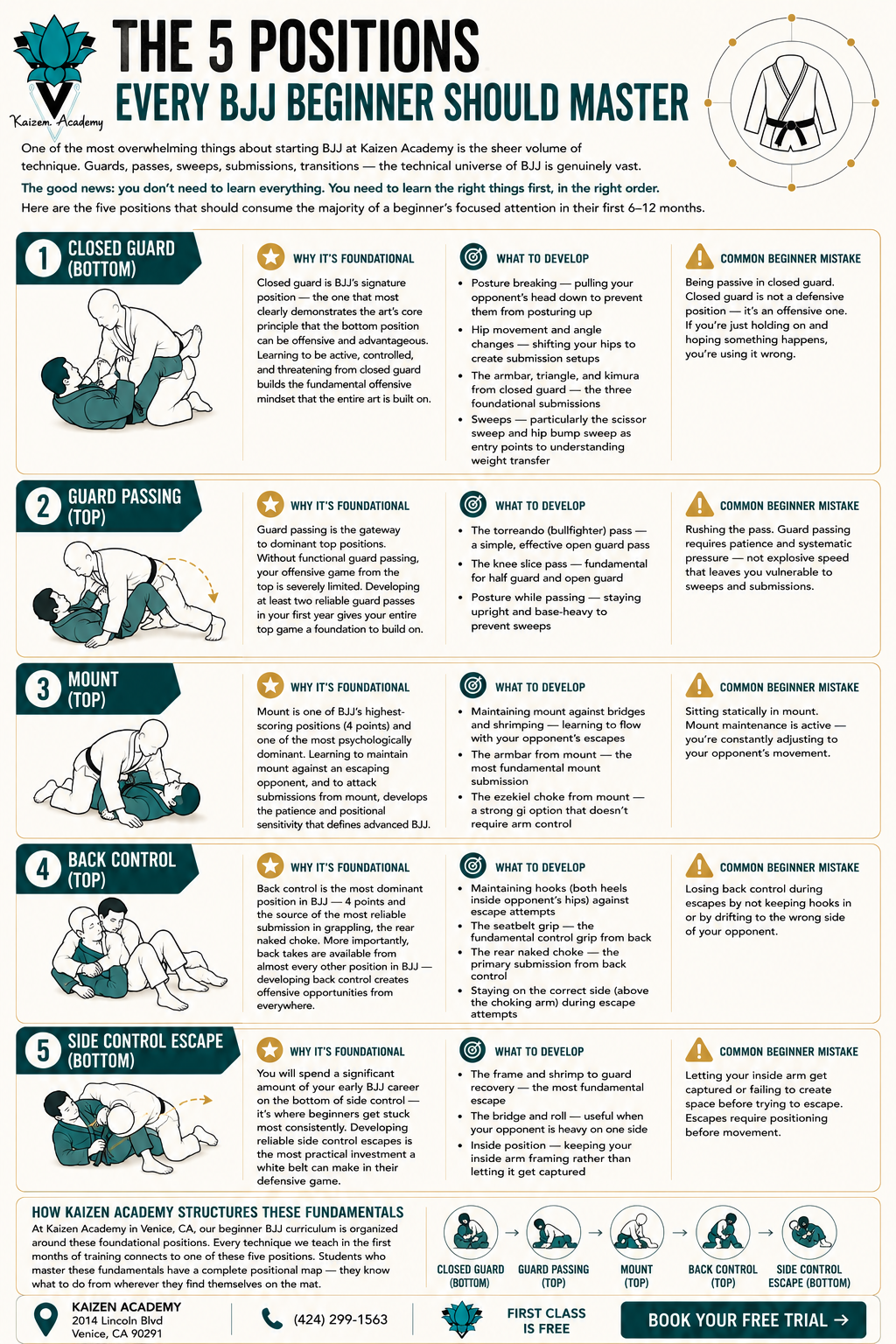
One of the most overwhelming things about starting BJJ at Kaizen Academy is the sheer volume of technique. Guards, passes, sweeps, submissions, transitions — the technical universe of BJJ is genuinely vast.
The good news: you don't need to learn everything. You need to learn the right things first, in the right order. Here are the five positions that should consume the majority of a beginner's focused attention in their first 6–12 months.
Why it's foundational: Closed guard is BJJ's signature position — the one that most clearly demonstrates the art's core principle that the bottom position can be offensive and advantageous. Learning to be active, controlled, and threatening from closed guard builds the fundamental offensive mindset that the entire art is built on.
What to develop in closed guard:
Common beginner mistake: Being passive in closed guard. Closed guard is not a defensive position — it's an offensive one. If you're just holding on and hoping something happens, you're using it wrong.
Closed guard is worth understanding in depth — see our complete guide to guard in BJJ.
Why it's foundational: Guard passing is the gateway to dominant top positions. Without functional guard passing, your offensive game from the top is severely limited. Developing at least two reliable guard passes in your first year gives your entire top game a foundation to build on.
What to develop:
Common beginner mistake: Rushing the pass. Guard passing requires patience and systematic pressure — not explosive speed that leaves you vulnerable to sweeps and submissions.
For the full breakdown, read our complete guard passing guide.
Why it's foundational: Mount is one of BJJ's highest-scoring positions (4 points) and one of the most psychologically dominant. Learning to maintain mount against an escaping opponent, and to attack submissions from mount, develops the patience and positional sensitivity that defines advanced BJJ.
What to develop:
Common beginner mistake: Sitting statically in mount. Mount maintenance is active — you're constantly adjusting to your opponent's movement.
More detail in our complete guide to the mount position.
Why it's foundational: Back control is the most dominant position in BJJ — 4 points and the source of the most reliable submission in grappling, the rear naked choke. More importantly, back takes are available from almost every other position in BJJ — developing back control creates offensive opportunities from everywhere.
What to develop:
Why it's foundational: You will spend a significant portion of your early BJJ career on the bottom of side control — it's where beginners get stuck most consistently. Developing reliable side control escapes is the most practical investment a white belt can make in their defensive game.
What to develop:
At Kaizen Academy in Venice, CA, our beginner BJJ curriculum is organized around these foundational positions. Every technique we teach in the first months of training connects to one of these five positions. Students who master these fundamentals have a complete positional map — they know what to do from wherever they find themselves on the mat.
If you're ready to turn these fundamentals into mat time, you can view the current BJJ class schedule and find a class that fits your week.
Kaizen Academy is at 2014 Lincoln Blvd, Venice, CA 90291. First class is free.