How to Survive Your First BJJ Roll — A Beginner's Tactical Guide
Your first live BJJ roll will feel chaotic. Here's the tactical approach Kaizen Academy in Venice, CA recommends for beginners to get maximum value from early sparring sessions.
Your first live BJJ roll will feel chaotic. Here's the tactical approach Kaizen Academy in Venice, CA recommends for beginners to get maximum value from early sparring sessions.
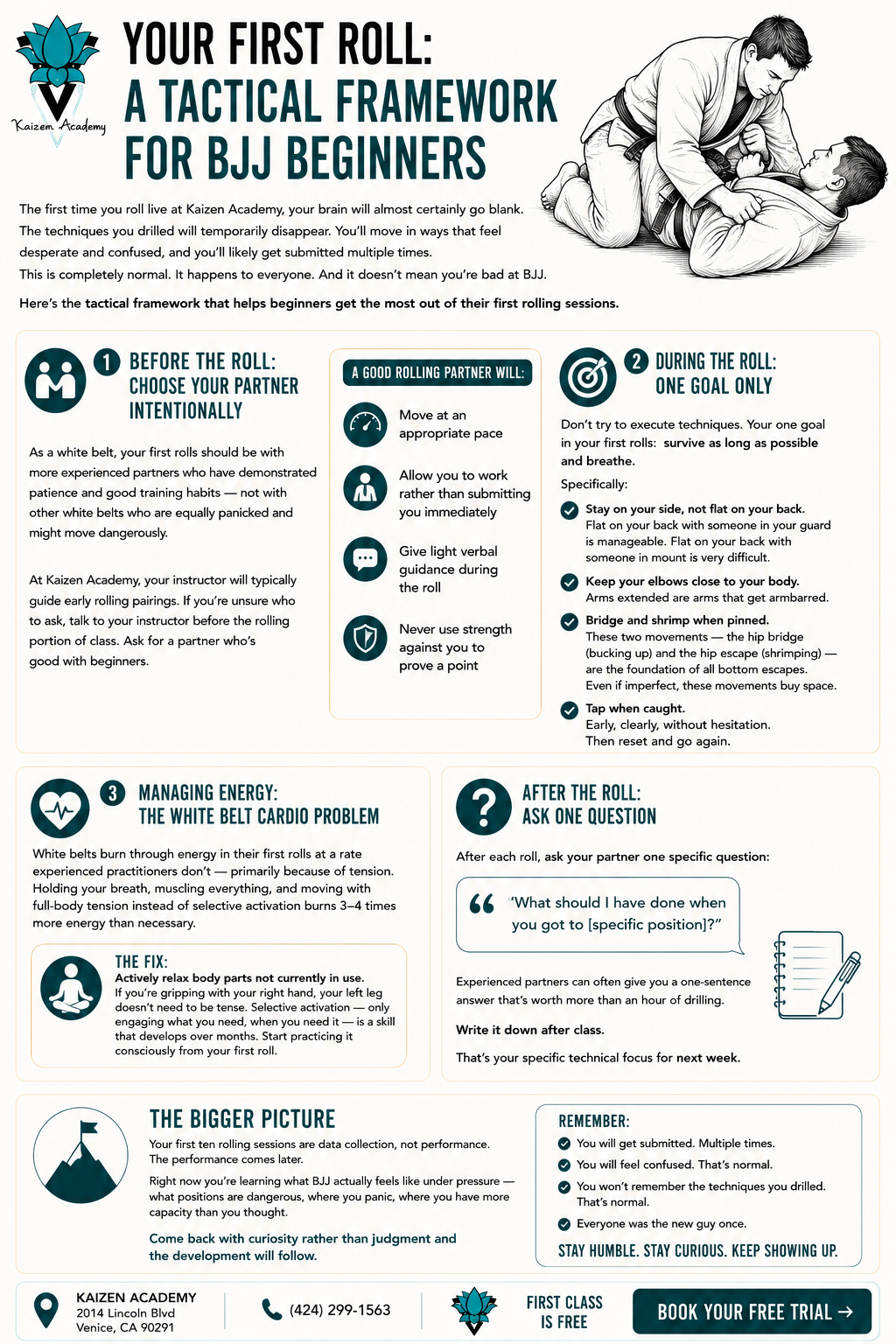

The first time a new student engages in live BJJ rolling, survival instinct takes over and technique goes out the window. This beginner's guide from Kaizen Academy in Venice, CA gives new students a specific tactical framework for their first rolling sessions — how to approach partners, what positions to focus on, how to manage energy, and how to process the experience productively.
The first time you roll live at Kaizen Academy, your brain will almost certainly go blank. The techniques you drilled will temporarily disappear. You'll move in ways that feel desperate and confused, and you'll likely get submitted multiple times.
This is completely normal. It happens to everyone. And it doesn't mean you're bad at BJJ.
Here's the tactical framework that helps beginners get the most out of their first rolling sessions.
As a white belt, your first rolls should be with more experienced partners who have demonstrated patience and good training habits — not with other white belts who are equally panicked and might move dangerously.
At Kaizen Academy, your instructor will typically guide early rolling pairings. If you're unsure who to ask, talk to your instructor before the rolling portion of class. Ask for a partner who's good with beginners.
A good rolling partner for a white belt will:
Choosing the right training partners matters well beyond your first roll — here's our full guide on how to pick a good rolling partner in BJJ.
Don't try to execute techniques. Your one goal in your first rolls: survive as long as possible and breathe.
Specifically:
White belts burn through energy in their first rolls at a rate experienced practitioners don't — primarily because of tension. Holding your breath, muscling everything, and moving with full-body tension instead of selective activation burns 3–4 times more energy than necessary.
The fix: Actively relax body parts not currently in use. If you're gripping with your right hand, your left leg doesn't need to be tense. Selective activation — only engaging what you need, when you need it — is a skill that develops over months. Start practicing it consciously from your first roll.
After each roll, ask your partner one specific question: "What should I have done when you got to [specific position]?"
Experienced partners can often give you a one-sentence answer that's worth more than an hour of drilling. Write it down after class. That's your specific technical focus for next week.
Your first ten rolling sessions are data collection, not performance. The performance comes later. Right now you're learning what BJJ actually feels like under pressure — what positions are dangerous, where you panic, where you have more capacity than you thought.
Come back with curiosity rather than judgment and the development will follow.
When you're ready to start training, our beginner BJJ classes are built for people who have never trained before. You can also check the current class schedule and choose a time that works for you.