BJJ Glossary — 50 Terms Every Beginner Should Know
Walking into your first BJJ class at Kaizen Academy in Venice, CA feels easier when you know the language. Here are 50 essential BJJ terms explained for complete beginners.
Walking into your first BJJ class at Kaizen Academy in Venice, CA feels easier when you know the language. Here are 50 essential BJJ terms explained for complete beginners.
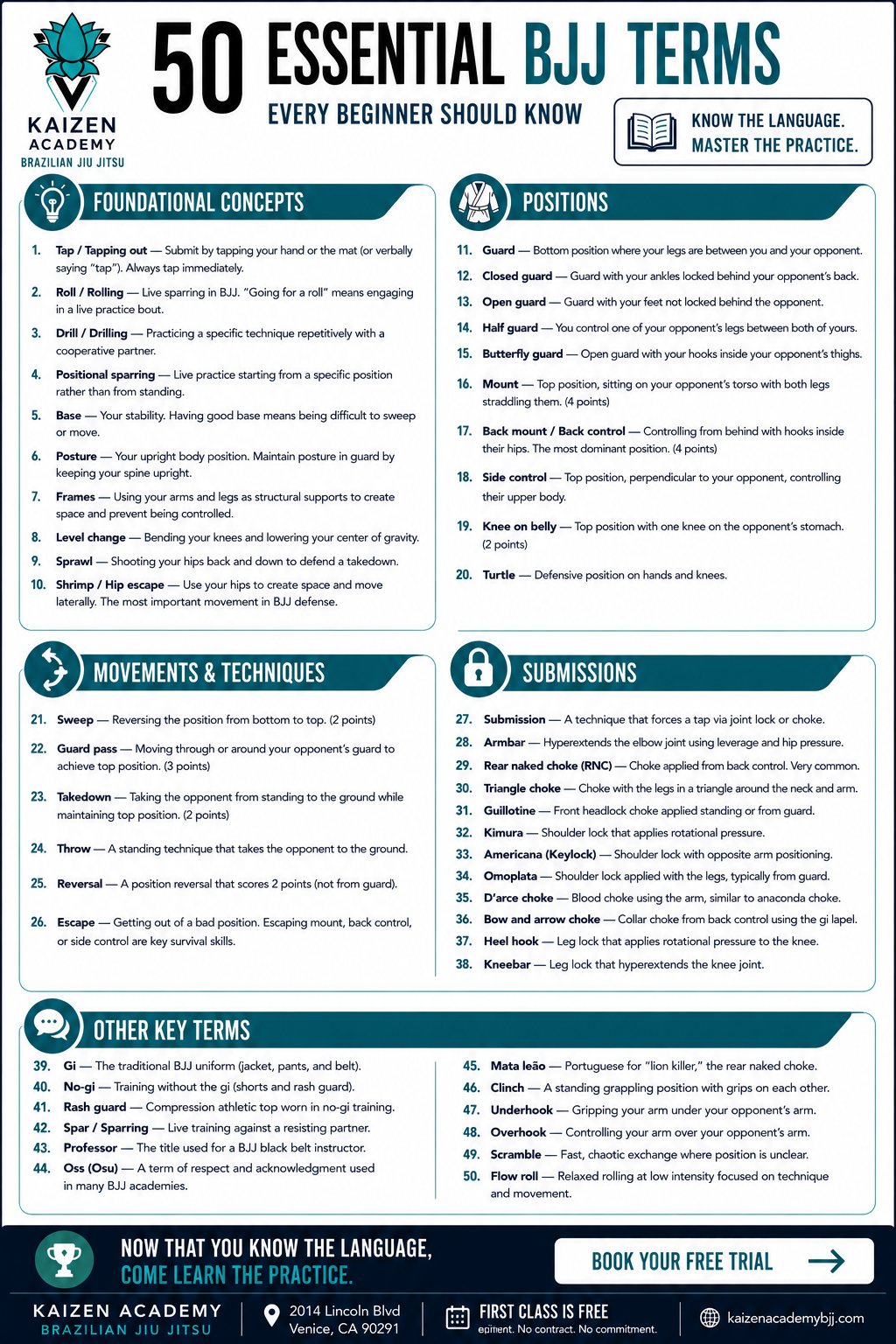

Brazilian Jiu Jitsu has its own rich vocabulary — positions, techniques, concepts, and Portuguese terms that can make early classes feel like a foreign language. This complete glossary from Kaizen Academy in Venice, CA defines 50 of the most important terms beginners will encounter in their first months of training, organized from foundational concepts to specific techniques.
Walking into Kaizen Academy for the first time, you'll hear terms that sound completely foreign — guard, sweep, shrimp, armbar, kimura, triangle, sprawl. Understanding the vocabulary makes everything that follows easier to absorb.
Here are 50 essential BJJ terms every beginner should know, organized from foundational to more specific.
1. Tap / Tapping out — Submitting by tapping your hand on your partner or the mat (or verbally saying "tap"). This signals the end of a submission attempt. Always tap immediately when caught — never tough it out.
2. Roll / Rolling — Live sparring in BJJ. "Going for a roll" means engaging in a live practice bout with a training partner.
3. Drill / Drilling — Practicing a specific technique repetitively with a cooperative partner. The foundation of technical development.
4. Positional sparring — Live practice starting from a specific position (e.g., one person in guard) rather than from standing. Focused development tool.
5. Base — Your stability. Having good base means being difficult to sweep or move. Losing your base means being vulnerable to being swept or taken down.
6. Posture — Your upright body position. Maintaining posture in guard means keeping your spine upright. Broken posture means being pulled down and controlled.
7. Frames — Using your arms and legs as structural supports to create space and prevent being controlled. Framing is a foundational defensive skill.
8. Level change — Bending your knees and lowering your center of gravity — essential for takedowns.
9. Sprawl — A defensive movement where you shoot your hips back and down to defend a takedown attempt.
10. Shrimp / Hip escape — A foundational BJJ movement where you use your hips to create space and move laterally. The single most important movement in BJJ defense.
11. Guard — The bottom position where your legs are between you and your opponent. Being "in guard" is actually a strong position in BJJ — from here you can sweep, submit, and control.
12. Closed guard — Guard with your ankles locked behind your opponent's back. Classic BJJ position.
13. Open guard — Guard with your feet not locked behind the opponent — various leg configurations instead.
14. Half guard — You control one of your opponent's legs between both of yours.
15. Butterfly guard — Open guard where your feet (hooks) are inside your opponent's thighs.
16. Mount — Top position where you're sitting on your opponent's torso with both legs straddling them. Highly dominant position — 4 points in competition.
17. Back mount / Back control — Controlling your opponent from behind with hooks (feet) inside their hips. The most dominant position in BJJ — 4 points.
18. Side control — Top position where you're perpendicular to your opponent on the ground, controlling their upper body without your legs in guard.
19. Knee on belly — Top position with one knee on the opponent's stomach. Uncomfortable for the bottom person and scores 2 points.
20. Turtle — A defensive position on hands and knees when being taken down or escaping a submission attempt.
21. Sweep — Reversing the position from bottom to top. Scores 2 points in competition.
22. Guard pass — Moving through or around your opponent's guard to achieve a dominant top position. Scores 3 points.
23. Takedown — Taking the opponent from standing to the ground while maintaining top position. Scores 2 points.
24. Throw — A standing technique that takes the opponent to the ground — borrowed largely from Judo.
25. Reversal — A position reversal that scores 2 points — similar to a sweep but from positions other than guard.
26. Escape — Getting out of a bad position. Escaping mount, back control, or side control are fundamental survival skills.
27. Submission — A technique that forces a tap — typically by applying pain or mechanical disadvantage to a joint, or by choking.
28. Armbar — A submission that hyperextends the elbow joint by controlling the arm and applying hip pressure.
29. Rear naked choke (RNC) — A choke applied from back control, with one arm across the throat and the other behind the head. The most common submission in MMA.
30. Triangle choke — A choke applied with the legs in a triangular configuration around the opponent's neck and arm.
31. Guillotine — A front headlock choke applied standing or from guard.
32. Kimura — A shoulder lock that applies rotational pressure to the shoulder joint. Named after judoka Masahiko Kimura.
33. Americana (Keylock) — A shoulder lock similar to the kimura but with opposite arm positioning — typically applied from mount or side control.
34. Omoplata — A shoulder lock applied with the legs — typically from guard.
35. D'arce choke — A blood choke applied using the arm — similar to the anaconda choke.
36. Bow and arrow choke — A collar choke applied from back control using the gi lapel.
37. Heel hook — A leg lock that applies rotational pressure to the knee by controlling the heel. More common in no-gi and advanced competition.
38. Kneebar — A leg lock that hyperextends the knee joint — similar mechanics to an armbar but on the leg.
39. Gi — The traditional BJJ uniform — jacket, pants, and belt.
40. No-gi — Training without the gi — in shorts and rash guard.
41. Rash guard — The compression athletic top worn in no-gi training.
42. Spar / Sparring — Live training against a resisting partner.
43. Professor — The title used for a BJJ black belt instructor.
44. Oss (Osu) — A multipurpose term of acknowledgment, respect, and affirmation used in many BJJ academies. Often used when acknowledging instruction.
45. Mata leão — Portuguese for "lion killer" — the rear naked choke.
46. Clinch — A standing grappling position where both competitors are gripping each other close to the body.
47. Underhook — Gripping your arm under your opponent's arm — a fundamental control position in wrestling and BJJ.
48. Overhook — Controlling your arm over the opponent's arm. The opposite of an underhook.
49. Scramble — A fast, chaotic exchange where both competitors are moving rapidly and position is temporarily unclear. Common in no-gi.
50. Flow roll — A relaxed, cooperative sparring session at low intensity focused on movement and technique rather than competition. Excellent for drilling concepts in a live environment.
Now that you know the language, come learn the practice.
Kaizen Academy is at 2014 Lincoln Blvd, Venice, CA 90291. First class is free.