The Flexibility Myth That Keeps People Off the Mat
We hear it at least once a week at Kaizen Academy in Venice, CA: "I'd love to try BJJ, but I'm not flexible enough." Sometimes it comes from a guy in his 40s who can barely touch his knees. Sometimes it comes from a former athlete who's spent years behind a desk. Occasionally it comes from someone who genuinely tried yoga once, couldn't do a single pose, and decided their body wasn't cut out for any physical discipline that involves the floor.
Here's the truth: you do not need to be flexible to start Brazilian jiu-jitsu. In fact, the idea that flexibility is a prerequisite is one of the most persistent and damaging myths that keeps people from trying one of the most effective martial arts in existence.
Let's break down what BJJ actually requires, how it affects flexibility over time, and what you can do to support your body as you train.
What BJJ Actually Requires (Hint: It's Not the Splits)
Brazilian jiu-jitsu is a grappling art. It involves controlling another person, managing distance, applying leverage, and using technique to overcome strength or size. It is done in close contact, often on the ground, and involves a lot of positional transitions.
Does any of that require being able to touch your toes? No. Does it require sitting in the full lotus position? No. Does it require the kind of flexibility you see in gymnastics or yoga demonstrations? Absolutely not.
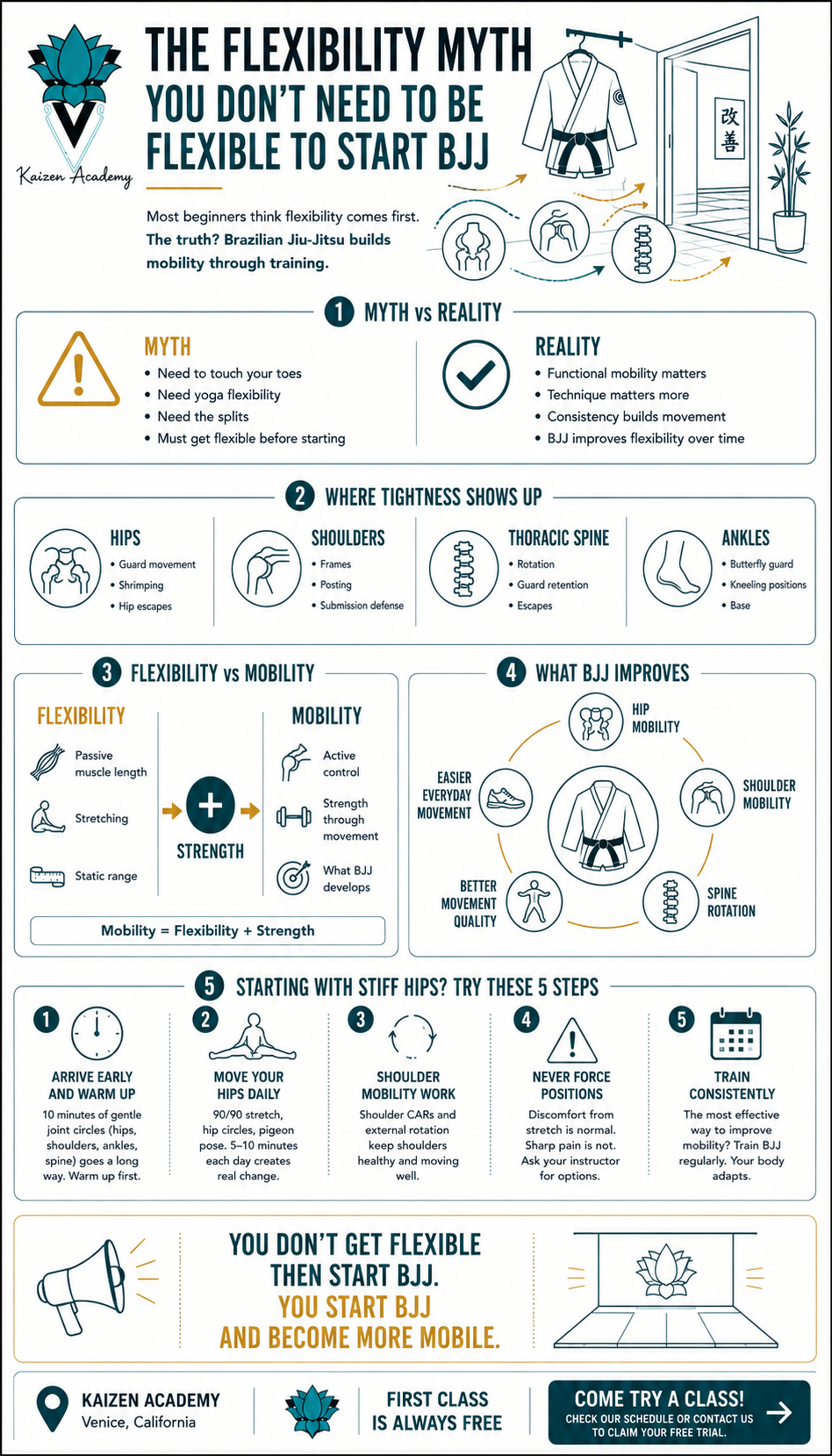
What BJJ does require, over time, is functional mobility — the ability to move your joints through their natural range of motion with control. This is very different from flexibility, which is simply the passive length of your muscles. Functional mobility is something almost everyone can develop, regardless of their starting point.
The most important physical attributes for a BJJ beginner are actually: being able to breathe under pressure, having enough hip and shoulder mobility to not injure yourself, and showing up consistently. That's it. Everything else develops through training.
Where Tightness Actually Shows Up in BJJ
That said, there are specific areas where limited range of motion can create friction in BJJ training — particularly early on. Being aware of them helps you understand what to address.
Hips. Hip mobility is probably the most relevant physical attribute for BJJ. Many positions — guard, mount, side control, and transitions between them — involve moving the hips in ways that desk-bound adults haven't done since childhood. Tight hip flexors and hip rotators make these transitions harder but not impossible. They will loosen over time.
Shoulders. Many submissions target the shoulder joint. Tight internal or external shoulder rotation can make defending certain submissions (and applying others) more challenging. Regular shoulder mobility work makes a significant difference.
Spine and thoracic mobility. The ability to rotate through the thorax helps in guard passing, escaping, and generating power. Chronic upper back tightness — extremely common in office workers — can be a limiting factor that improves dramatically with training and targeted mobility work.
Ankles. Less commonly discussed, but ankle dorsiflexion affects how comfortably you can sit in certain positions, including butterfly guard and various kneeling positions. This tends to improve passively through training.
None of these tightnesses disqualify you from training. They're just areas to be aware of.
How BJJ Actually Improves Your Flexibility
Here's the thing nobody advertises clearly enough: BJJ is one of the best things you can do for your flexibility and mobility.
When you train BJJ consistently, your body is regularly placed in positions that stretch and mobilize your joints — not as a deliberate exercise protocol, but as a side effect of the movement demands. Your hips get opened up in ways that years of static stretching often fail to achieve. Your shoulders develop resilient mobility because they have to work through full ranges under load. Your spine rotates and flexes in all directions.
Within six months of consistent training, most students notice significant improvements in their overall movement quality — not just for BJJ, but in everyday life. Sitting cross-legged. Reaching overhead. Getting up from the floor. Rotating to look behind you. These things become easier because you've been training movement patterns that are foundational to human mobility.
A study published in the Journal of Human Kinetics found that BJJ practitioners showed significantly greater hip and spine mobility compared to non-practitioners — and the improvements were correlated with training volume. The longer you train, the more your body opens up.
The Difference Between Flexibility and Mobility
These terms are often used interchangeably but they describe different things, and understanding the difference matters for BJJ.
Flexibility is the passive ability of a muscle to lengthen. You can test it by having someone else move your limb through its range. High flexibility doesn't automatically translate to functional movement.
Mobility is active control through a range of motion. It requires both the flexibility to get there and the strength and neuromuscular coordination to move through the range with control.
BJJ develops mobility. Static yoga-style stretching primarily develops flexibility. Both have value, but mobility is what you actually need on the mat — and it's what training directly develops.
This is why you'll often see BJJ practitioners who can't do a standing forward fold but can move their hips in remarkably fluid, complex ways during rolling. They've developed the functional mobility that their training demands, even without the passive flexibility of a gymnast.
How to Support Your Body When You Start
If you're starting BJJ with limited mobility, here are some practices that will accelerate your adaptation:
Arrive early and move. Ten minutes of gentle joint circles — hips, shoulders, ankles, spine — before class will do more for your on-mat comfort than almost anything else. Don't stretch cold, especially static stretching. Warm up first.
Hip mobility work. Exercises like the 90/90 hip stretch, hip circles, and the pigeon stretch done regularly off the mat will translate directly to easier movement in guard and transitions. Five to ten minutes daily is enough to see real change.
Shoulder circles and external rotation work. A few minutes of shoulder CARs (controlled articular rotations) daily will help keep your shoulders resilient and comfortable as you train.
Don't force positions. In your early training, if a position feels uncomfortable, tell your instructor. There are usually modifications or adjustments. Pushing through sharp joint pain is never the answer. Discomfort from stretching is normal; sharp pain is a signal to back off.
Train consistently. The most effective way to improve your BJJ-specific mobility is to train BJJ regularly. Your body adapts to the demands you place on it. Consistent training is the most powerful mobility protocol available to you.
What Highly Flexible People Need to Know
A quick note for the outlier: if you are already very flexible — hypermobile, perhaps — BJJ comes with its own set of considerations for you.
Hypermobile individuals can sometimes get into positions that provide less warning before a joint reaches its limit. They may also find that certain submission defenses rely on their body being looser than a tighter opponent's would be. This is something to discuss with your instructor so they can help you train in ways that build stability alongside your existing range of motion.
Hypermobility without corresponding strength and control is a risk factor for injury in any physical activity. BJJ, done well, will help you build the strength and neuromuscular control to stabilize your joints — but the process requires awareness.
You Don't Need to Get Flexible Before You Start
We want to say this one more time, because this is the point that matters most: you do not need to spend three months doing yoga before you're "ready" for BJJ. You don't need to be able to do the splits. You don't need to pass some flexibility threshold before you belong on the mat.
You belong on the mat right now, with the body you have today. The training will meet you where you are and move you forward from there.
At Kaizen Academy in Venice, CA, we work with students of all body types, ages, and fitness levels. Our instructors understand that tight hips and stiff shoulders are the norm, not the exception — especially in adults who've spent years working desk jobs or in careers that limit movement. We'll help you build the mobility you need as part of your BJJ development.
Come Try a Class
If flexibility concerns have been holding you back from trying BJJ, we hope this post has given you the permission you needed. Come see for yourself. You'll be surprised how quickly your body adapts to the movement demands — and how good it feels to move in ways you haven't in years.
Check out our beginner classes in Venice, CA or contact us to schedule a free trial. We'd love to show you what your body is actually capable of.