How BJJ Develops Problem-Solving Skills — On and Off the Mat
Every round of BJJ is a live problem-solving exercise under pressure. Here's how training at Kaizen Academy in Venice, CA builds cognitive skills that transfer far beyond the mat.
Every round of BJJ is a live problem-solving exercise under pressure. Here's how training at Kaizen Academy in Venice, CA builds cognitive skills that transfer far beyond the mat.
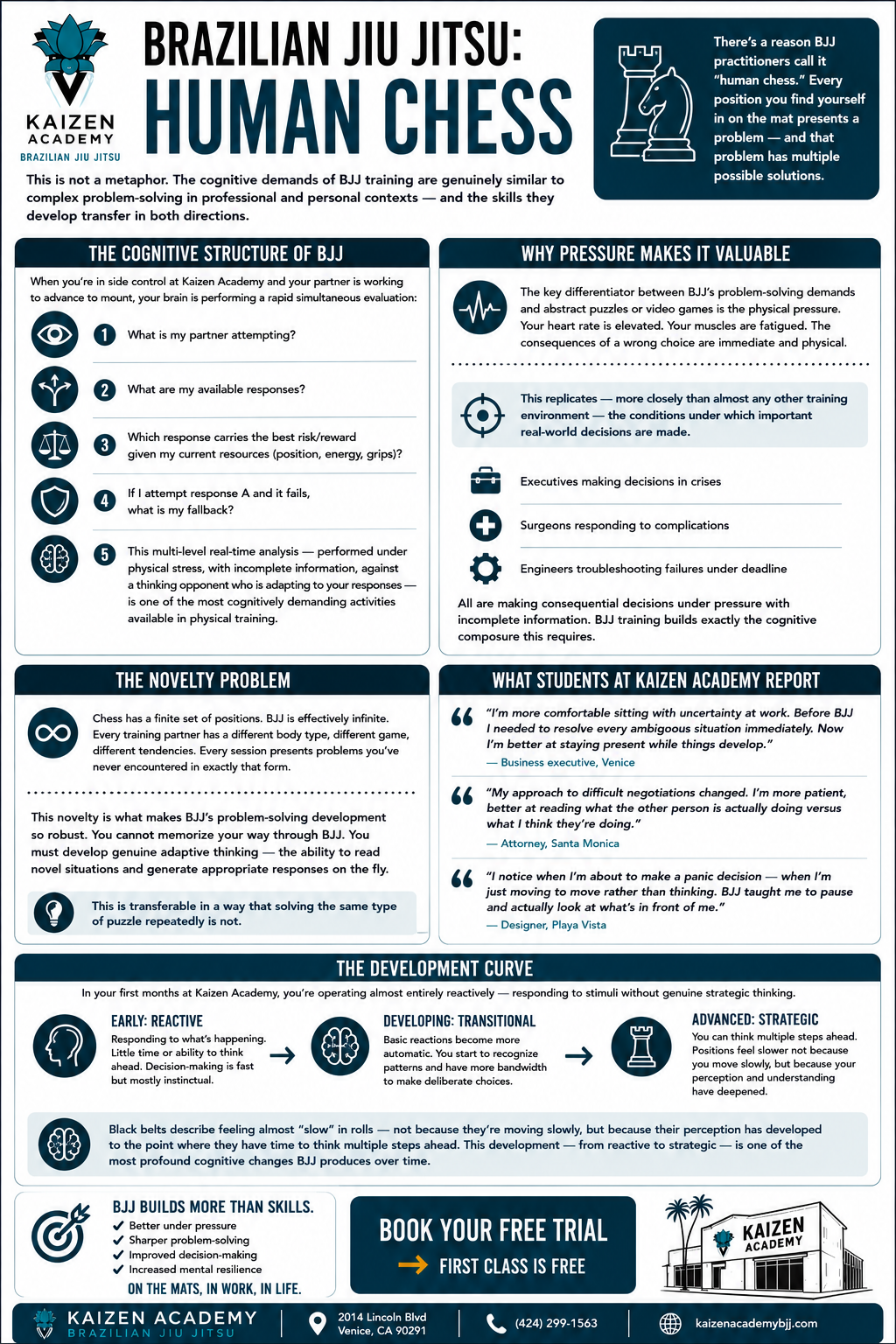

Brazilian Jiu Jitsu is frequently described as "human chess" — and for good reason. The problem-solving demands of BJJ training are unique among physical activities: real-time, high-stakes, physically embodied, and constantly novel. This post from Kaizen Academy in Venice, CA explores the specific cognitive mechanisms through which BJJ develops problem-solving ability and how those skills transfer to professional and personal life.
There's a reason BJJ practitioners call it "human chess." Every position you find yourself in on the mat presents a problem — and that problem has multiple possible solutions, each with downstream consequences, each requiring rapid evaluation and execution under pressure.
This is not a metaphor. The cognitive demands of BJJ training are genuinely similar to complex problem-solving in professional and personal contexts — and the skills they develop transfer in both directions.
When you're in side control at Kaizen Academy and your partner is working to advance to mount, your brain is performing a rapid simultaneous evaluation:
This multi-level real-time analysis — performed under physical stress, with incomplete information, against a thinking opponent who is adapting to your responses — is one of the most cognitively demanding activities available in physical training.
The key differentiator between BJJ's problem-solving demands and abstract puzzles or video games is the physical pressure. Your heart rate is elevated. Your muscles are fatigued. The consequences of a wrong choice are immediate and physical. This replicates — more closely than almost any other training environment — the conditions under which important real-world decisions are made.
Executives making decisions in crises, surgeons responding to complications, engineers troubleshooting failures under deadline — all are making consequential decisions under pressure with incomplete information. BJJ training builds exactly the cognitive composure this requires.
Chess has a finite set of positions. BJJ is effectively infinite. Every training partner has a different body type, different game, different tendencies. Every session presents problems you've never encountered in exactly that form.
This novelty is what makes BJJ's problem-solving development so robust. You cannot memorize your way through BJJ. You must develop genuine adaptive thinking — the ability to read novel situations and generate appropriate responses on the fly. This is transferable in a way that solving the same type of puzzle repeatedly is not.
Students who train at Kaizen Academy consistently report noticing changes in how they approach problems outside the gym:
"I'm more comfortable sitting with uncertainty at work. Before BJJ I needed to resolve every ambiguous situation immediately. Now I'm better at staying present while things develop." — Business executive, Venice
"My approach to difficult negotiations changed. I'm more patient, better at reading what the other person is actually doing versus what I think they're doing." — Attorney, Santa Monica
"I notice when I'm about to make a panic decision — when I'm just moving to move rather than thinking. BJJ taught me to pause and actually look at what's in front of me." — Designer, Playa Vista
In your first months at Kaizen Academy, you're operating almost entirely reactively — responding to stimuli without genuine strategic thinking. As you develop, reactive responses become more automatic, freeing cognitive bandwidth for actual strategy. Black belts describe feeling almost "slow" in rolls — not because they're moving slowly, but because their perception has developed to the point where they have time to think multiple steps ahead.
This development — from reactive to strategic — is one of the most profound cognitive changes BJJ produces over time.
Kaizen Academy is at 2014 Lincoln Blvd, Venice, CA 90291. First class is free.