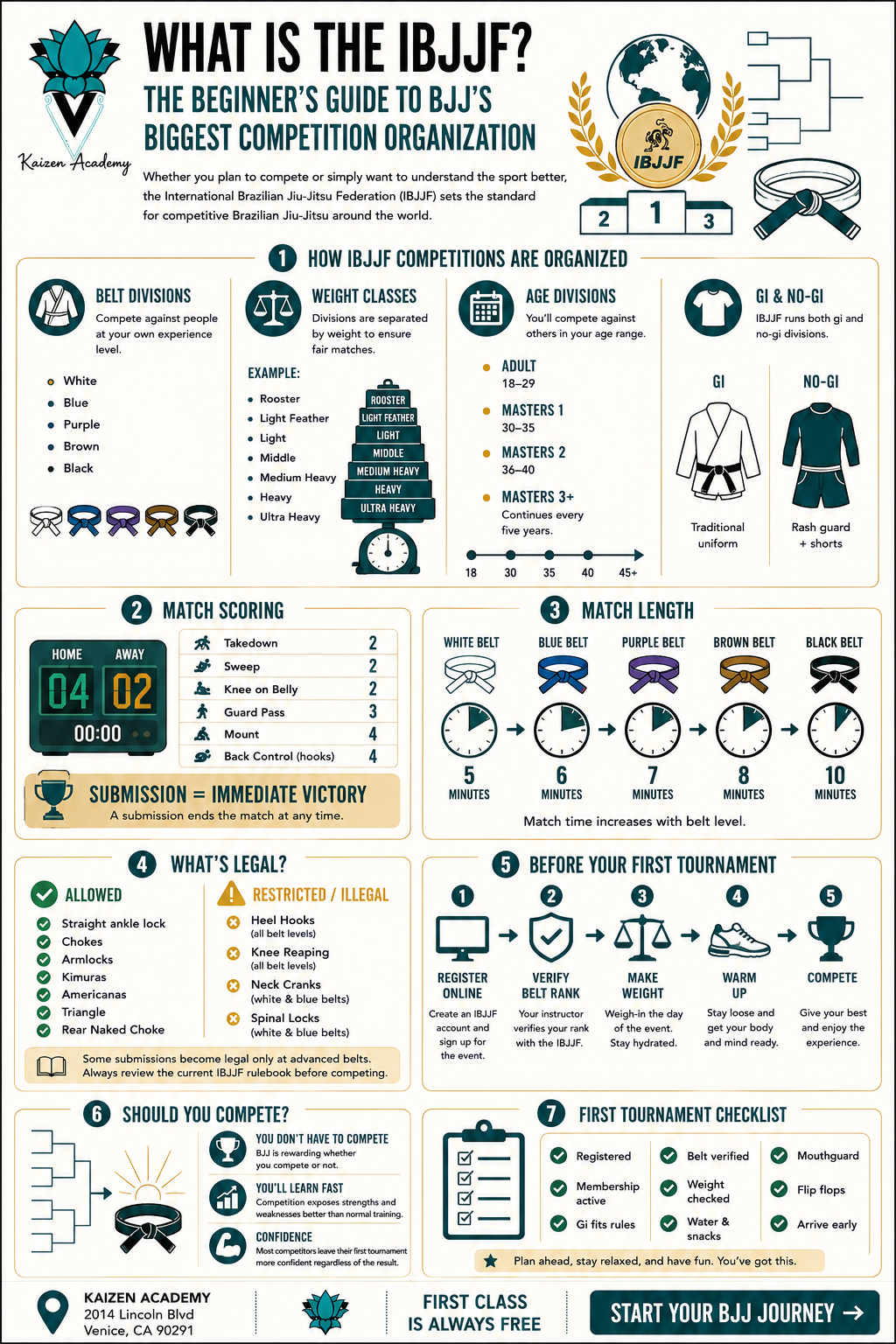
What Is the IBJJF?
The International Brazilian Jiu-Jitsu Federation, commonly known as the IBJJF, is the largest and most recognized governing body in competitive Brazilian jiu-jitsu. Founded in 2002 by Carlos Gracie Jr. under the umbrella of the Confederação Brasileira de Jiu-Jitsu (CBJJ), the organization oversees hundreds of tournaments worldwide each year and sets the technical and procedural standards that define competitive BJJ for much of the global community.
If you've heard of major competitions like the World IBJJF Jiu-Jitsu Championship (commonly called "Worlds"), the Pan American Championship ("Pans"), the European Championship, or the Brazilian Nationals, those are all IBJJF events. For most practitioners, the IBJJF represents the pinnacle of gi jiu-jitsu competition.
Understanding how IBJJF competitions work — even if you're not yet thinking about competing — helps you understand the sport you're learning and the context in which techniques are developed and refined.
How IBJJF Competitions Are Structured
IBJJF events are bracket-style tournaments with matches determined by weight class and belt level. Here's how the basic structure works:
Belt divisions. Competitors are divided by belt rank: white, blue, purple, brown, and black. This ensures you're competing against people at a roughly similar level of technical development.
Weight classes. Within each belt level, competitors are further divided by weight. Adult male divisions (in the gi) range from Rooster (57.5kg/127lbs) through Ultra Heavy (over 100kg/220lbs). Each division has specific weight limits that competitors must meet at weigh-in.
Age divisions. In addition to belt and weight, the IBJJF separates competitors by age. The main adult division covers ages 18–29. Masters divisions begin at 30 and go up in five-year increments (Masters 1: 30–35, Masters 2: 36–40, Masters 3: 41–45, and so on up to Masters 7 for competitors 66 and older). This is one of the most athlete-friendly aspects of IBJJF competition — you are never asked to compete against a 25-year-old at 50.
Gi and No-Gi. The IBJJF runs both gi (traditional uniform) and no-gi divisions, though the organization has historically been more associated with gi competition. No-gi events have grown significantly in recent years.
How Matches Are Scored
IBJJF scoring rewards dominant positional control and submission attempts. Here's the point system:
- Takedown: 2 points
- Sweep: 2 points
- Knee on belly: 2 points
- Guard pass: 3 points
- Mount: 4 points
- Back control (with hooks): 4 points
Points are only awarded after a 3-second stabilization in the position. Advantages (or "adv") are awarded for positional attempts or near-passes that don't fully meet the stabilization criteria. Advantages serve as a tiebreaker if point totals are equal at the end of a match.
Matches can also end by submission at any time — a submission victory always takes precedence over the scoreboard. Winning by submission is universally considered the most decisive outcome.
Match time varies by belt level. White belt adults typically compete in five-minute matches. Blue belt adult matches are six minutes. Purple, brown, and black belts compete for eight, nine, and ten minutes respectively.
What Techniques Are Allowed?
This is one of the most important things for new competitors to understand. The IBJJF has significant restrictions on which techniques are legal at each belt level — primarily to protect less experienced competitors from injuries caused by advanced submissions.
Heel hooks — both inside and outside — are illegal at all belt levels in IBJJF competition, except for nogi adult black belt. This is one of the most significant distinctions between IBJJF and other rule sets (such as EBI, ADCC, or Combat Jiu-Jitsu), where heel hooks are typically legal.
Reaping the knee (a specific leg entanglement position) is also illegal at all belt levels.
Spinal locks and neck cranks are illegal for white and blue belts and restricted at higher belts.
Straight ankle locks are legal for all belts. Knee bars, toe holds, and calf slicers are permitted starting at brown belt in gi competition and purple belt in no-gi.
Bicep slicers and calf slicers are generally restricted to advanced belts.
The full IBJJF rulebook is publicly available on their website and is worth reading before your first competition. Understanding what's legal and what isn't prevents disqualifications and, more importantly, prevents injuries.
IBJJF Membership and Registration
To compete in IBJJF-sanctioned events, both the competitor and the academy must be registered members of the organization. The IBJJF requires membership fees for athletes, and your belt rank must be verified through your instructor and the organization's database.
Your instructor at Kaizen Academy will handle the rank verification aspect. As a competitor, you'll need to create an account on the IBJJF website, purchase a membership, and register for specific events through their online portal. Event registration typically opens several weeks before the tournament and often sells out quickly for popular weight/belt/age divisions.
What It's Actually Like to Compete
Reading the rules is one thing. Experiencing a competition is another entirely.
Tournament venues are usually large convention centers or sports complexes with multiple mats running simultaneously. You'll check in, confirm your weight, and receive a competitor number. Then you wait — sometimes for hours — until your division is called. The waiting is one of the mentally challenging parts of competition that no amount of training fully prepares you for.
When your division starts, you'll be called to a mat for your first match. Everything happens fast. The match feels shorter than it is when you're in it. Your preparation — the drilling, the positional work, the conditioning — either shows up or it doesn't. There's no faking it on the competition mat.
Win or lose, competing is one of the most educational experiences available to a BJJ practitioner. It reveals gaps in your game with a clarity that drilling and even gym rolling can't replicate. Virtually every serious practitioner who competes describes their first tournament as a turning point in their development.
Should You Compete?
This is a question only you can answer, and the answer doesn't have to be permanent. Many people train BJJ their entire lives without ever competing. The sport doesn't require competition to be meaningful, effective, or deeply rewarding.
That said, if you're curious about competing, our general advice at Kaizen is: do it. Compete early in your BJJ journey, before you've had time to build up the story that you're "not ready." White belt competition is specifically designed for people who are new to the art. You'll face opponents at your own level, in a safe environment, with rules designed to protect inexperienced grapplers.
The growth you experience from competing — win, lose, or draw — is substantial. The confidence that comes from stepping onto a competition mat is real. And the lessons you learn about your own game are invaluable. Many practitioners who swear they'll never compete end up becoming regular competitors after their first tournament.
Preparing for Your First IBJJF Event
If you've decided to compete, here's a general preparation framework:
Give yourself enough time. Signing up for a competition 8–12 weeks out gives you enough runway to address specific gaps in your game without the preparation becoming stressful.
Train for your division's time limit. White belt adults compete for five minutes. Train five-minute rounds at competition intensity to build comfort with that timeframe.
Drill your A-game. Competition is not the time to experiment. Identify two or three positions and submissions you do well and drill them relentlessly. Repetition builds the automaticity you need under stress.
Manage your weight intelligently. Pick a weight class you can make without extreme cutting. Dehydration and dramatic weight cuts hurt performance. Train and compete at a healthy, sustainable weight.
Discuss your preparation with your instructor. Your coach at Kaizen can watch your rounds, identify patterns, and help you prepare strategically. Use that resource.
Kaizen Academy and Competition Culture
At Kaizen in Venice, CA, we support students who want to compete and students who don't with equal enthusiasm. Our adult BJJ classes develop the technical foundation and the live rolling experience that serve competitors and recreational practitioners alike. When students do decide to compete, we help them prepare with specific competition-oriented drilling and strategy work.
Whether your goal is a IBJJF gold medal or simply becoming a more capable and confident person, the path through Kaizen's door is the same first step.
Explore our adult BJJ program or reach out to learn more about our competition team and preparation resources. We're proud of our competitors and equally proud of every practitioner who shows up to train, regardless of whether they ever enter a bracket.