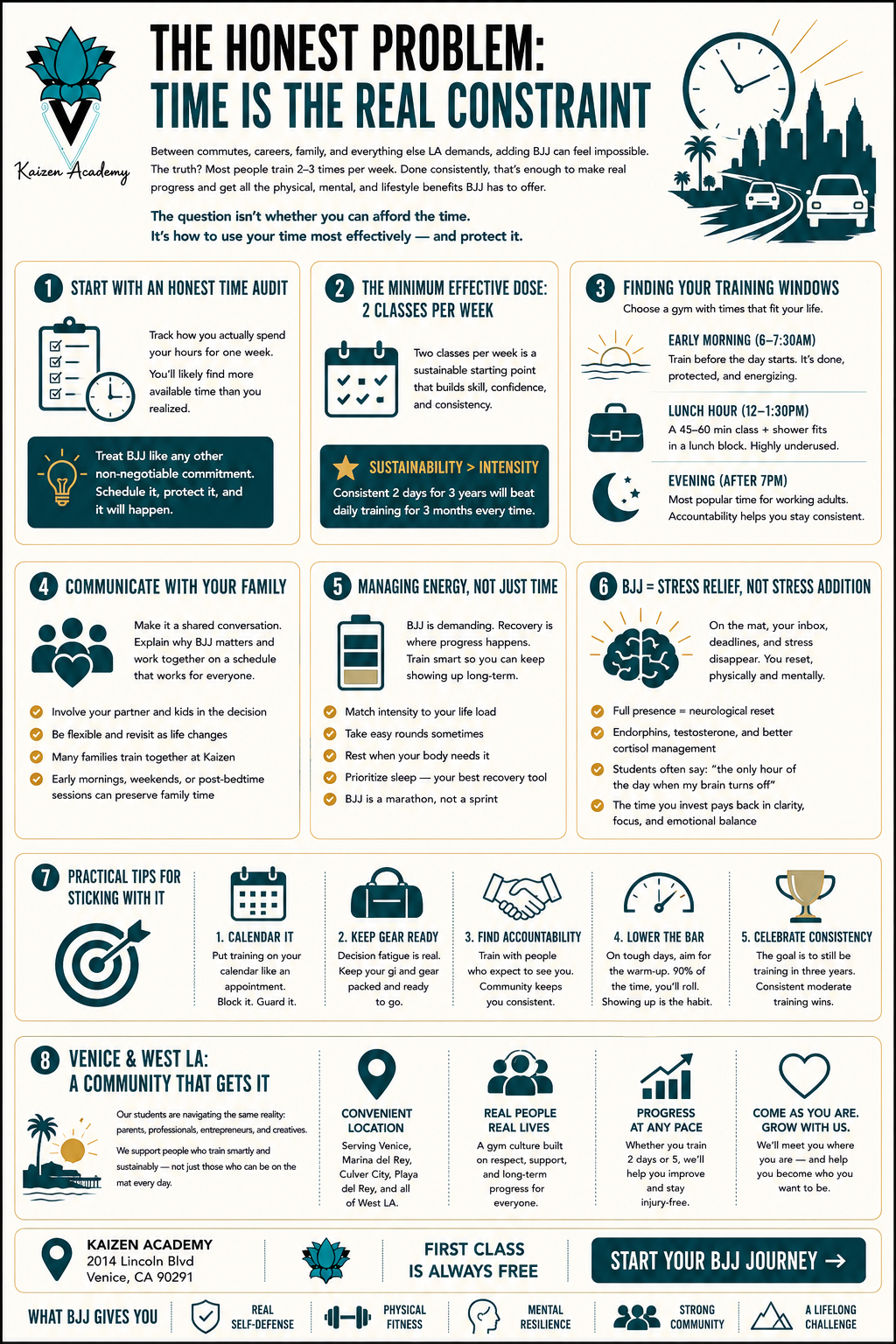
The Honest Problem: Time Is the Real Constraint
Los Angeles is not a city that goes easy on your schedule. Between the commute times, the work culture, the family commitments, and the city's endless social pull, most adults in LA are already operating at capacity. So when someone tells you to add Brazilian jiu-jitsu to your life — a martial art that serious practitioners train four to six times per week — it's reasonable to wonder how that's actually supposed to work.
The truth is that most BJJ practitioners aren't training six times a week. Most are training two to three times per week, working it into real lives with real constraints. And two to three times per week, done consistently over months and years, is enough to make meaningful progress, develop genuine skill, and gain all the physical and mental benefits the art has to offer.
The question isn't whether you can afford the time. The question is how to use the time you have most effectively — and how to protect it from everything else competing for it.
Start With an Honest Time Audit
Before you can balance BJJ with the rest of your life, you need to know where your time actually goes. Most people significantly underestimate how much time certain activities consume and overestimate how much discretionary time they have.
Spend one week tracking how you actually spend your hours. Where is time going that you don't consciously intend? Streaming services, social media, and the general drift of unstructured evening time are usually where the hours hide. Most people who do this audit discover they have more available time than they thought — it's just not organized or protected.
For BJJ to work in a busy schedule, it needs to be treated like any other non-negotiable commitment. If you schedule your training sessions the same way you schedule meetings, doctor appointments, and school pickups, they happen. If you leave them as aspirational open space, they get absorbed by everything else.
The Minimum Effective Dose: Two Classes Per Week
Two BJJ classes per week is a sustainable starting point that produces real results. It's enough frequency that your body starts building muscle memory, enough repetition that techniques consolidate between sessions, and enough contact time with training partners that you start to develop intuition for movement and position.
Two classes per week is also a commitment most working adults in Los Angeles can actually maintain — and maintenance is what produces long-term progress. A consistent two-days-a-week practitioner who trains for three years will far outpace someone who trains every day for three months and then burns out.
If two days feels sustainable, add a third when the rhythm is established. Most practitioners find that three sessions per week is the sweet spot — enough to progress meaningfully, not so much that it consumes everything else.
Finding Your Training Windows
One of the most practical challenges of BJJ in LA is finding a gym with class schedules that fit your actual life. Los Angeles traffic makes this a genuinely strategic decision — a gym that's geographically convenient and has classes at times that work for you is worth more than a prestigious gym that requires forty-five minutes each way during rush hour.
At Kaizen Academy in Venice, CA, we offer classes at multiple times throughout the day including morning, midday, and evening options — specifically because we know our students have diverse schedules. Whether you're a parent who can train after drop-off, a professional who can sneak in a lunch session, or someone who prefers to wind down their day on the mat, there's likely a window that works.
Some specific windows that work well for busy LA adults:
Early morning (6–7:30am). Training before the day starts is psychologically powerful — it's done, it's protected, and the energy it produces carries into your workday. This requires sleep discipline, but it's highly effective for people whose evenings are unpredictable.
Lunch hour. A 45–60 minute class plus a quick shower is achievable in a lunch block, particularly if you work near the gym. This is one of the most underutilized windows for adult practitioners.
Evening (after 7pm). The most popular training time for working adults. The challenge is consistency — something always seems to come up in the evening. If you train evenings, having a set partner or accountability buddy significantly improves follow-through.
Communicating With Your Family
For parents and partners, BJJ works best when it's a shared conversation, not a unilateral decision. The people you live with are the ones who feel the impact of your training schedule — whether it's the evenings you're gone, the early mornings when the alarm goes off, or the weekend tournament schedule.
When you include your family in the decision, explain why BJJ matters to you — the stress relief, the physical fitness, the personal challenge — and involve them in figuring out a schedule that works for everyone. Many partners who were initially skeptical become enthusiastic supporters once they see the positive effects BJJ has on mood, energy, and stress levels.
Some families find that training together creates a shared language and a shared activity that strengthens the relationship. Kaizen has families where multiple members train at different levels, and the culture on the mat carries into their dynamic at home.
If you have young children, the math is harder — but not impossible. Early morning sessions before they wake up, or evening sessions after bedtime, often preserve the most family time. Weekend sessions when a partner can be home can also work. Be flexible and creative, and revisit the schedule as family circumstances change.
Managing Energy, Not Just Time
One mistake busy people make when adding BJJ to their lives is treating it purely as a time management problem. But energy management matters just as much.
BJJ is physically demanding. After a high-intensity training session, most people need recovery time — both physical and mental. If you train hard five nights a week, your work performance, parenting quality, and general wellbeing will likely suffer. This is not sustainable.
The people who maintain BJJ training for decades are the ones who train intelligently. They manage their training intensity based on their overall life load. They take easy rounds sometimes instead of going hard every session. They rest when their body needs it. They prioritize sleep — the most important recovery tool available — even if it means missing a night class occasionally.
BJJ is a marathon, not a sprint. Protect your energy the same way you protect your time.
BJJ as Stress Relief, Not Stress Addition
Here's the paradox that many professionals in Los Angeles discover within their first few months of training: BJJ actually reduces the stress load of a busy life rather than adding to it.
When you're rolling, you cannot think about your inbox, your deadlines, your difficult client, or any of the chronic cognitive load of modern professional life. BJJ demands your full, present attention in a way that few activities do. This enforced presence functions as a neurological reset — and the endorphins, testosterone, and cortisol management that come with physical exertion compound the effect.
Many of our students at Kaizen describe their training sessions as "the only hour of the day when my brain turns off." That kind of recovery is genuinely valuable in a high-stress city and career. The time you invest in training often pays back more than it costs in cognitive clarity and emotional regulation.
Practical Tips for Sticking With It
Put your training on the calendar like an appointment. Block it as unavailable time. Guard it the way you'd guard a meeting with an important client.
Keep your gear bag packed. Decision fatigue is real. The fewer barriers between you and getting to the gym, the better. Keep your gi and gear ready so there's nothing to prepare.
Train with people who hold you accountable. When a training partner expects to see you on Tuesday night, you're far more likely to show up. Community is one of BJJ's greatest retention mechanisms.
Lower the bar on hard days. Tell yourself you'll just go for the warm-up and see how you feel. Ninety percent of the time, you'll roll. And even if you don't, you showed up — and showing up is the habit.
Celebrate consistency, not intensity. The goal is to still be training in three years. Consistent moderate training beats sporadic intense training every time.
Venice and West LA: A Community That Gets It
One of the reasons Kaizen works well for working adults in Los Angeles is that our community is made up of people navigating the same reality you are. Our students are parents, professionals, entrepreneurs, and creatives who are serious about their training and serious about their lives outside the gym. The culture supports people who train smartly and sustainably — not just those who can be on the mat every day.
If you're based in Venice, Marina del Rey, Culver City, Playa del Rey, or anywhere in West LA, Kaizen is close enough that the logistical barrier is low. We'd love to be part of how you manage your health, stress, and personal development in a city that demands a lot from you.
Check out our class schedule or reach out to set up a free trial. We'll work with you to find a training frequency and schedule that fits your life — not the other way around.