Los Angeles is one of the most anxiety-producing environments on earth. Long commutes, competitive professional culture, social comparison, the ambient pressure of living in a city that never stops moving — it adds up. And the standard interventions — apps, therapy, yoga, meditation — work for some people some of the time.
But at Kaizen Academy in Venice, CA, we watch something different happen. Students who came in for fitness leave with something harder to name: a genuinely different relationship with discomfort, pressure, and the moments in life where things go sideways.
Here's what's behind it.
The Physiology of Anxiety on the Mat
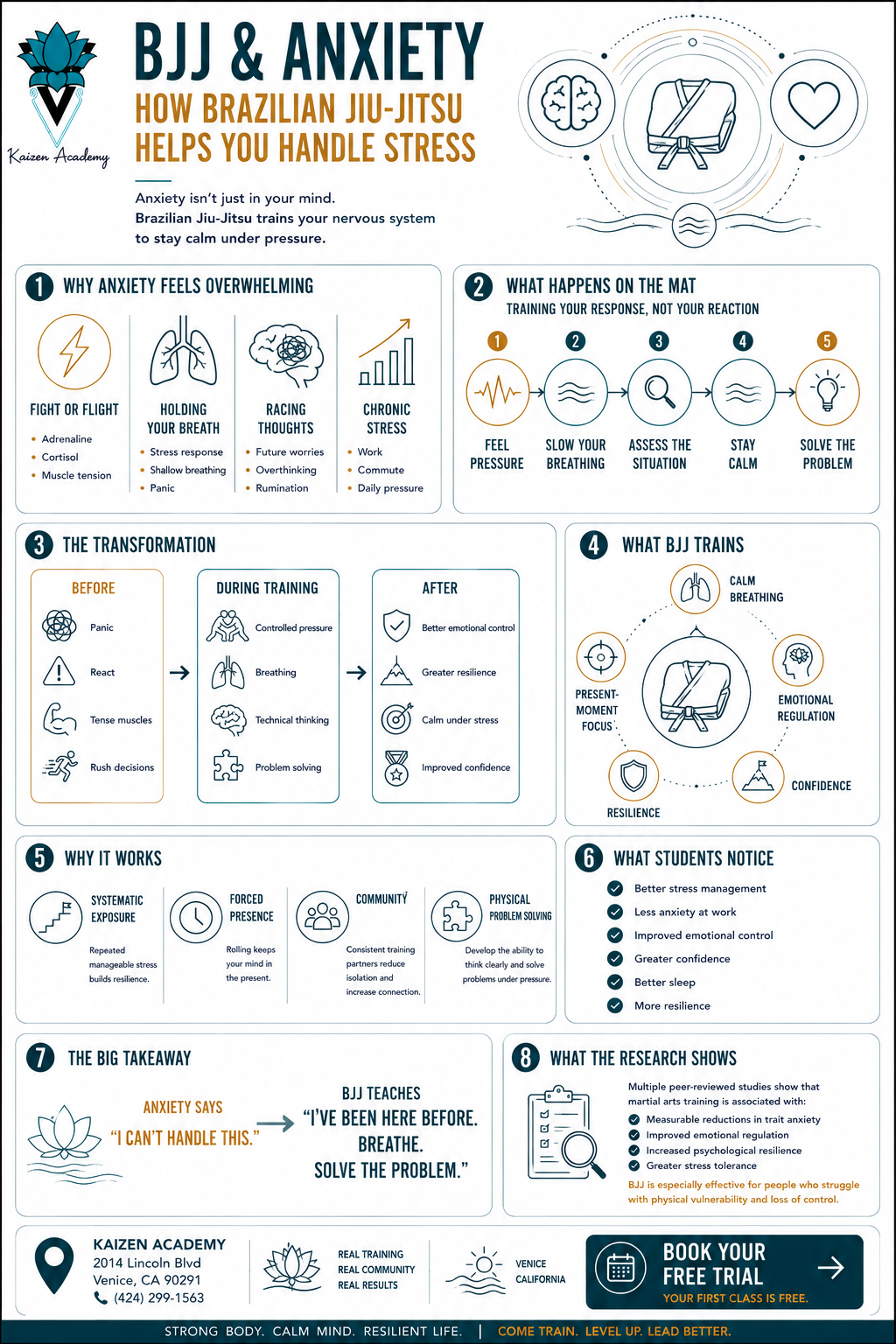
When someone has physical control over your body, your nervous system reads it as a genuine threat. The brain floods with cortisol and adrenaline. The instinctive response is to thrash, tense up, hold your breath, and try to escape immediately — whether or not that's the right thing to do.
This is the same neurological response pattern that produces anxiety in non-physical situations: a difficult conversation, a high-stakes presentation, unexpected bad news. The body doesn't distinguish well between physical threat and social threat — both activate the same fight-or-flight system.
BJJ training gives you hundreds of repetitions of encountering that exact activation state — and choosing a different response. Breathe. Assess. Move strategically rather than reactively. That's not a metaphor for anxiety management; it's the literal skill being developed on the mat.
Systematic Exposure to Manageable Stress
One of the most effective clinical treatments for anxiety is exposure therapy — systematic, graduated exposure to anxiety-producing stimuli until the nervous system recalibrates its threat response. BJJ is essentially exposure therapy embedded in a sport you actually want to show up for.
Every class at Kaizen Academy places you in uncomfortable situations: physically controlled, submitted, struggling. And every time you navigate that discomfort and come back the next class, you're building the experiential evidence that discomfort is survivable. That evidence accumulates.
Students consistently report — usually around the 3–6 month mark — that their response to non-BJJ stress has changed. The difficult conversation that would have produced a panic response now produces the same focused calm that a bad position on the mat requires. This transfer isn't inevitable, but it's consistent enough across enough students that it's genuinely predictable.
Forced Presence Eliminates Rumination
Anxiety lives in the past and the future. It is the replay of what went wrong and the anticipation of what might go wrong. What anxiety cannot survive is genuine present-moment engagement — and BJJ creates forced presence like almost nothing else.
When someone is actively passing your guard, there is zero mental bandwidth available for anything other than this position, right now. Your inbox doesn't exist. Your deadline doesn't exist. The complicated relationship doesn't exist. There is only the mat, the moment, and your breathing.
Two hours on the mat is two hours completely outside your own head. For people who struggle to achieve that through meditation or other practices, BJJ delivers it as a byproduct of training.
Community as Mental Health Infrastructure
Isolation amplifies anxiety. Social connection reduces it. This is not spiritually abstract — it's neurobiological. Regular, meaningful social connection suppresses cortisol production and activates oxytocin pathways that directly counter the biochemistry of anxiety.
The community at Kaizen Academy — the training partners you see every week, the shared challenge and shared growth, the genuine relationships built through physical trust — provides a social support structure that carries its own independent mental health benefit, separate from anything that happens during training itself.
Many students describe the gym as the one place in their week where everything else genuinely disappears. For the people carrying significant stress loads — and most of our students are — that's not a small thing.
What the Research Shows
Multiple peer-reviewed studies have examined the relationship between martial arts training and anxiety. Consistent findings include measurable reductions in trait anxiety, improvements in emotional regulation, and increased psychological resilience among regular martial arts practitioners. BJJ specifically — because of its ground-fighting intimacy and the sustained problem-solving it requires — appears particularly effective for people who struggle with anxiety around physical vulnerability and loss of control.
If you're dealing with anxiety and looking for something that addresses it at the level of your nervous system — not just your cognition — BJJ is worth serious consideration.
For a closer look at the physiology, read our breakdown of how BJJ reduces stress and why the mat is the best therapy.
Kaizen Academy is at 2014 Lincoln Blvd, Venice, CA 90291. Your first class is free.
Book your free trial →