BJJ Injuries — How to Train Smart and Stay Healthy Long-Term
BJJ has a reputation for injuries — but most are preventable. Here's how to train smart and stay healthy long-term at Kaizen Academy in Venice, CA.
BJJ has a reputation for injuries — but most are preventable. Here's how to train smart and stay healthy long-term at Kaizen Academy in Venice, CA.
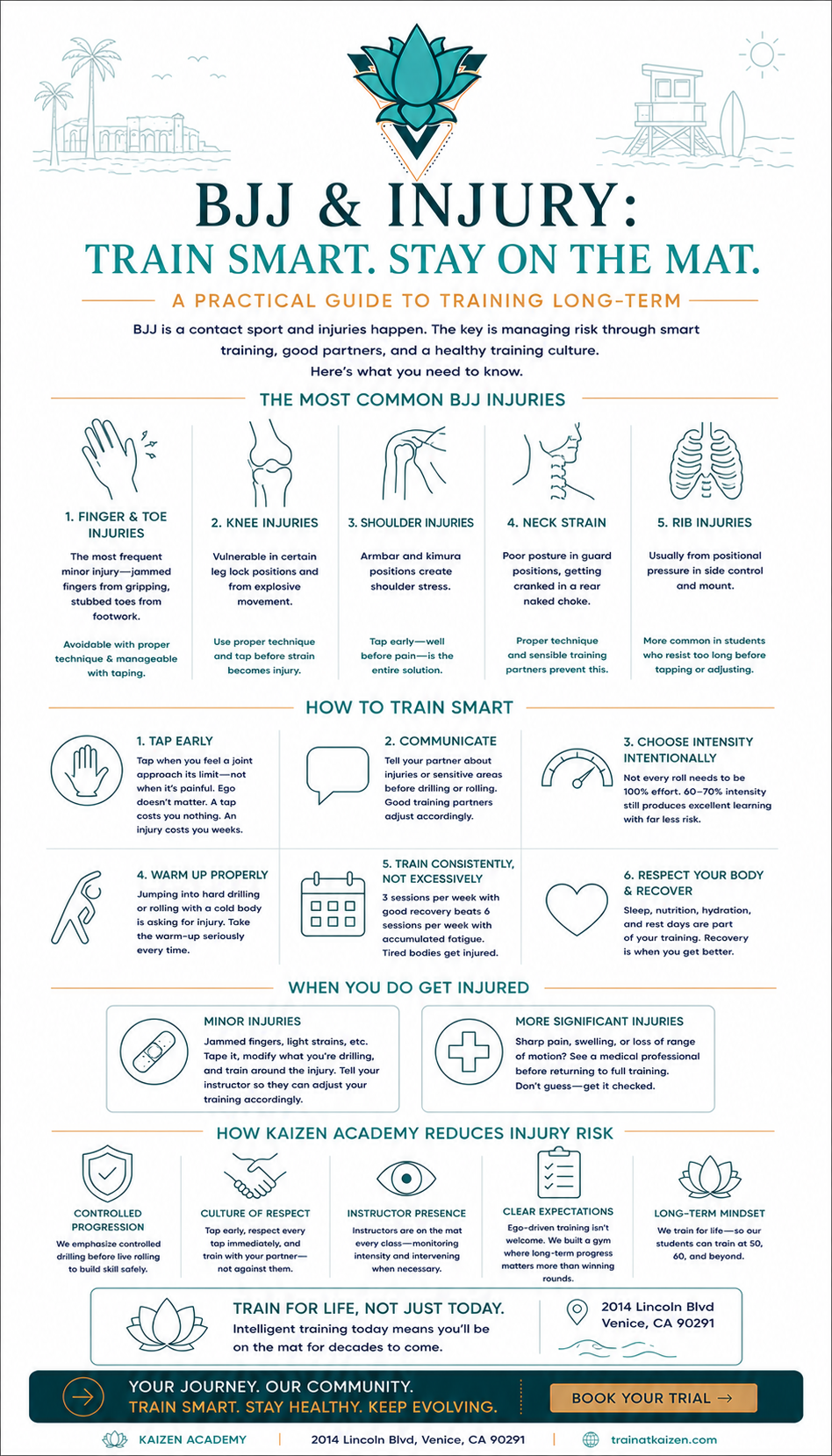

Injuries are the most common reason BJJ students quit training. This post covers the most common BJJ injuries, how to prevent them through smart training practices, how to manage common issues when they arise, and how Kaizen Academy in Venice, CA structures training to minimize injury risk for students of all levels.
Let's be honest: BJJ is a contact sport and injuries happen. Anyone who tells you otherwise is either lying or hasn't been training long enough. But the reputation BJJ has for being injury-heavy is largely a product of poor training culture and ego-driven sparring — not an inherent feature of the art itself.
At Kaizen Academy in Venice, CA, our approach to training is specifically designed to keep students healthy for the long term. Here's what you need to know.
Finger and toe injuries. The most frequent minor injury in BJJ — jammed fingers from gripping, stubbed toes from footwork. Mostly avoidable through proper technique and manageable through taping.
Knee injuries. The knee is vulnerable in certain leg lock positions and from explosive movement. Proper technique and knowing when to tap before strain becomes injury prevents most knee problems.
Shoulder injuries. Armbar and kimura positions create shoulder stress. Tapping early — well before pain — is the entire solution here.
Neck strain. Poor posture in guard positions, getting cranked in a rear naked choke — both avoidable with proper technique and sensible training partners.
Rib injuries. Usually from positional pressure in side control and mount. More common in students who resist too long before tapping or adjusting.
Tap early. We say this constantly at Kaizen Academy and it cannot be overstated. Tapping when you feel a joint approach its limit — not when it's painful — keeps you on the mat. Ego-driven refusal to tap is the single greatest cause of BJJ injuries. A tap costs you nothing. An injury costs you weeks.
Communicate with your partners. If you're nursing an injury or a sensitive area, tell your partner before drilling or rolling. Good training partners adjust accordingly.
Choose your rolling intensity intentionally. Not every roll needs to be 100% effort. Technical rolling at 60–70% intensity produces excellent learning and dramatically reduces injury risk.
Warm up properly. Jumping into hard drilling or rolling with a cold body is asking for injury. Take the warm-up seriously even when you feel fine.
Train consistently at moderate frequency rather than intensely at high frequency. Three sessions per week with good recovery beats six sessions per week with accumulated fatigue. Tired bodies get injured.
Minor injuries — jammed fingers, light strains — generally don't require you to stop training. Tape, modify what you're drilling, and train around the injury. Tell your instructor so they can adjust your training accordingly.
More significant injuries — anything involving sharp pain, swelling, or loss of range of motion — should be evaluated by a medical professional before returning to full training.
At Kaizen Academy, we structure training deliberately to protect our students:
The students who train at Kaizen for years without significant injury aren't lucky. They're smart about how they train.
The goal is to be training BJJ at 50, 60, and beyond. That requires training intelligently from day one.
Kaizen Academy at 2014 Lincoln Blvd, Venice, CA 90291. First class is free.