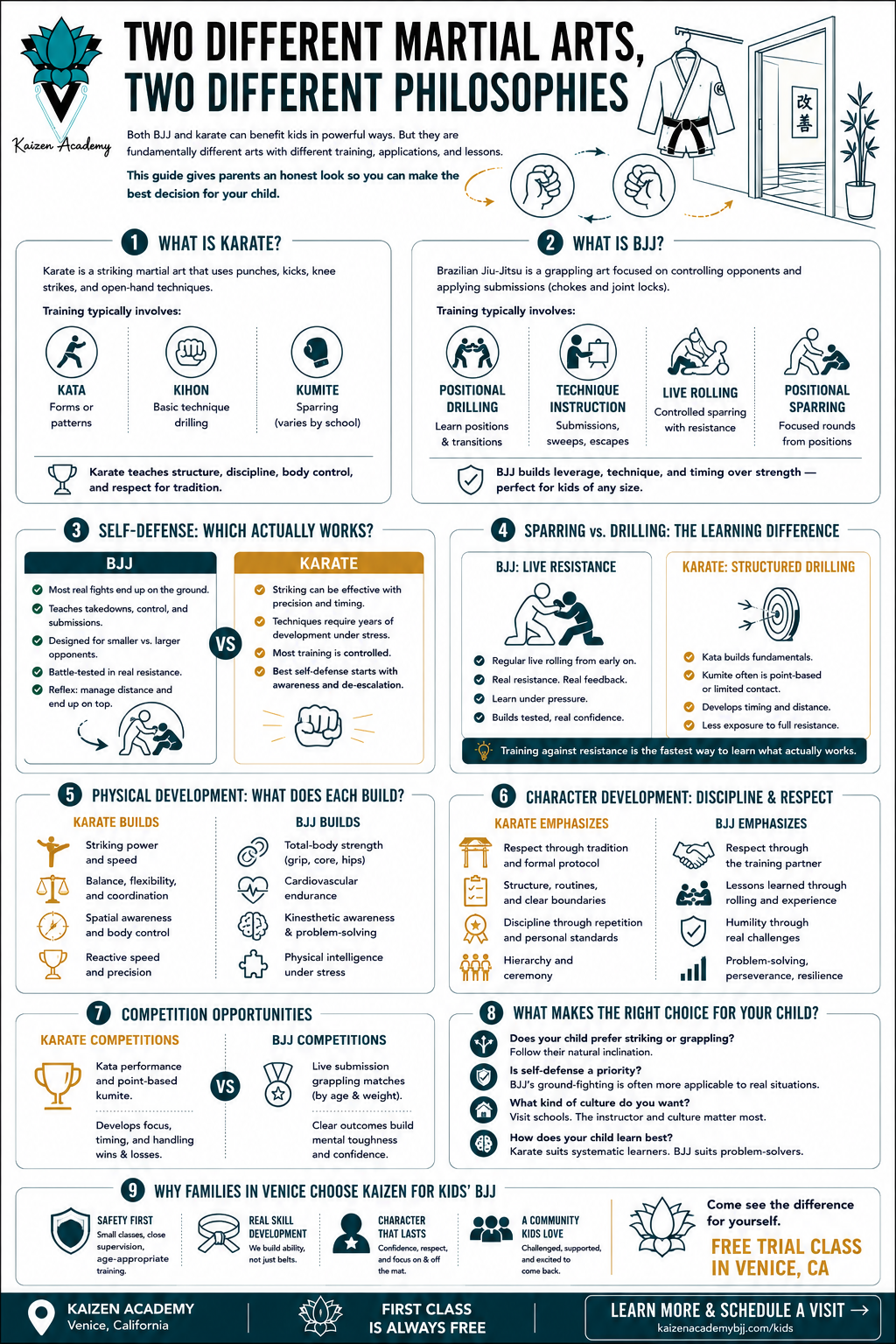
Two Different Martial Arts, Two Different Philosophies
When parents in Venice, CA start looking for martial arts classes for their kids, two names come up most often: BJJ (Brazilian jiu-jitsu) and karate. Both are legitimate disciplines with long histories. Both can benefit children in meaningful ways. But they are fundamentally different arts with different training methods, different applications, and different lessons they teach kids about themselves and the world.
This guide isn't meant to declare a winner. It's meant to give parents an honest look at what each art actually involves so you can make the best decision for your child.
What Is Karate?
Karate is a striking martial art that originated in Okinawa, Japan and developed through influence from Chinese martial arts. It focuses primarily on punches, kicks, knee strikes, and open-hand techniques. Training typically involves:
- Kata — choreographed forms or patterns of movement practiced solo
- Kihon — basic technique drilling
- Kumite — sparring (the style and intensity varies by school)
Karate is widely practiced worldwide and has been an Olympic sport since 2021. It teaches structure, discipline, body control, and respect for tradition.
What Is BJJ?
Brazilian jiu-jitsu is a grappling martial art focused on ground fighting and submissions — chokes and joint locks — that allow a smaller person to control or submit a larger, stronger opponent. It developed from Judo and Kodokan judo through the Gracie family in Brazil and has become one of the most widely practiced martial arts in the world, particularly due to its effectiveness in mixed martial arts competition.
BJJ training for kids involves:
- Positional drilling — learning specific positions and transitions
- Technique instruction — submissions, sweeps, escapes
- Live rolling — controlled sparring against resisting partners
- Positional sparring — focused rounds from specific positions
The core philosophy is leverage, technique, and timing over strength — making it exceptionally well-suited for children who may one day face a larger bully or aggressor.
Self-Defense: Which Actually Works?
This is where the two arts diverge most significantly for practical purposes.
The reality of physical confrontations — especially for children — is that they almost always end up on the ground. Pushing, shoving, and wrestling are far more common in schoolyard conflicts than the kind of precision striking that karate trains. A child who knows how to clinch, take an opponent down, and control them from a dominant position has an enormous advantage in a real situation.
BJJ is designed around the premise that if you're smaller or weaker, you need a technical system that neutralizes those disadvantages. That system has been battle-tested in competitive environments for decades. When children who train BJJ are grabbed or shoved, their reflexive response is to manage distance and go to the ground — where their training lives.
Karate's striking techniques can absolutely be effective, but they require significant precision and timing under stress — skills that take years to develop and can break down under adrenaline. Most karate schools also practice striking with control, meaning kids rarely experience the full-resistance application of their techniques.
That said, the best self-defense is awareness and de-escalation — which both arts can teach in their own way.
Sparring vs. Drilling: The Learning Difference
One of the most meaningful structural differences between BJJ and traditional karate is how often students train against resisting partners.
In BJJ, live rolling — where both partners are actively trying to achieve their goals against each other — is a regular, frequent part of training from early on. This gives students immediate feedback on what works and what doesn't. They learn under pressure, with real resistance, in a safe and supervised environment.
Many traditional karate schools spar infrequently or with significant restrictions. Point-style kumite involves touch contact and stopping to reset, which develops timing but doesn't simulate the sustained resistance of a real confrontation.
The value of training against resistance cannot be overstated. It builds confidence that is tested and verified, not just theoretically claimed.
Physical Development: What Does Each Art Build?
Both arts build fitness, but in different ways.
Karate develops striking power, balance, flexibility, and coordination. The kata practice develops spatial awareness and body control. Competition karate builds reactive speed.
BJJ develops total-body strength (especially grip strength, core, and hip power), cardiovascular endurance, kinesthetic awareness, and the ability to problem-solve physically under stress. Grappling is metabolically demanding — a hard sparring session is genuine full-body exercise. It also develops unusual physical intelligence: the ability to read another body's weight and intentions through contact.
For children specifically, BJJ's emphasis on body control, core strength, and physical problem-solving translates well to other sports and physical activities.
Character Development: Discipline, Confidence, and Respect
Both martial arts have strong traditions of teaching respect, discipline, and perseverance. Here's how they tend to differ in application:
Karate often emphasizes formality — bowing, following strict protocols, respecting the dojo hierarchy. This structure can be excellent for children who need clear boundaries and routines.
BJJ also teaches respect and structure, but the lessons are often delivered through the rolling itself. When a smaller child submits a larger one through technique, or taps out safely and returns to drilling, they're learning lessons about ego, persistence, and problem-solving that can't be fully communicated in words. The mat is an honest teacher.
Both arts, when taught well, produce kids who are more confident, more focused, and more respectful. The vehicle is different; the destination is similar.
Competition Opportunities
Both arts offer strong competition opportunities for kids at local, regional, and national levels.
Karate competitions typically involve kata performance and point-based kumite. BJJ competitions involve live submission grappling matches in age and weight divisions. Both develop the ability to perform under pressure, manage nerves, and handle wins and losses with grace.
Many families find that competing in BJJ is particularly formative because it puts children in a genuinely challenging, fully resisted situation where the outcome is unambiguous — you either submitted your opponent or you didn't. This clarity can be a powerful teacher.
What Makes the Right Choice for Your Child?
There's no universal answer, but here are some questions that can help guide your decision:
Does your child prefer striking or grappling? Some kids light up at the idea of punches and kicks; others are natural wrestlers. Follow their inclination.
Does your child struggle with bully situations? If real-world self-defense is a priority, BJJ's ground-fighting system is generally considered more applicable to the scenarios kids actually face.
What kind of culture do you want your child in? Visit schools for both. Watch how instructors interact with students. The quality of the instruction and the gym culture matters far more than the art itself.
Is your child highly structured or do they thrive with problem-solving? Karate's kata practice suits systematic learners. BJJ's live rolling suits kids who think on their feet.
Why Families in Venice Choose Kaizen for Kids' BJJ
At Kaizen Academy in Venice, CA, our kids' program is built around three things: safety, skill development, and character. We train in small-sided groups so every child gets real attention. Our instructors understand child development and adjust their teaching style accordingly. And we create an environment where kids are challenged but never demeaned — a place they're excited to come back to.
Our students develop real BJJ ability, not just colored belts. And we see the confidence and discipline they build on the mat carry over into school, friendships, and family life in ways that make parents genuinely proud.
If you're curious about whether BJJ is right for your child, we invite you to come in for a free trial class. See the environment, meet the instructors, and let your kid feel what it's like. We're confident you'll see the difference.
Learn more about our kids' BJJ program or reach out to set up a visit. We'd love to meet your family.