How Kaizen Academy Approaches Kids Curriculum — A Parent's Inside Look
What actually happens in a kids BJJ class at Kaizen Academy in Venice, CA? Here's the inside look at our curriculum, structure, and developmental philosophy for parents.
What actually happens in a kids BJJ class at Kaizen Academy in Venice, CA? Here's the inside look at our curriculum, structure, and developmental philosophy for parents.
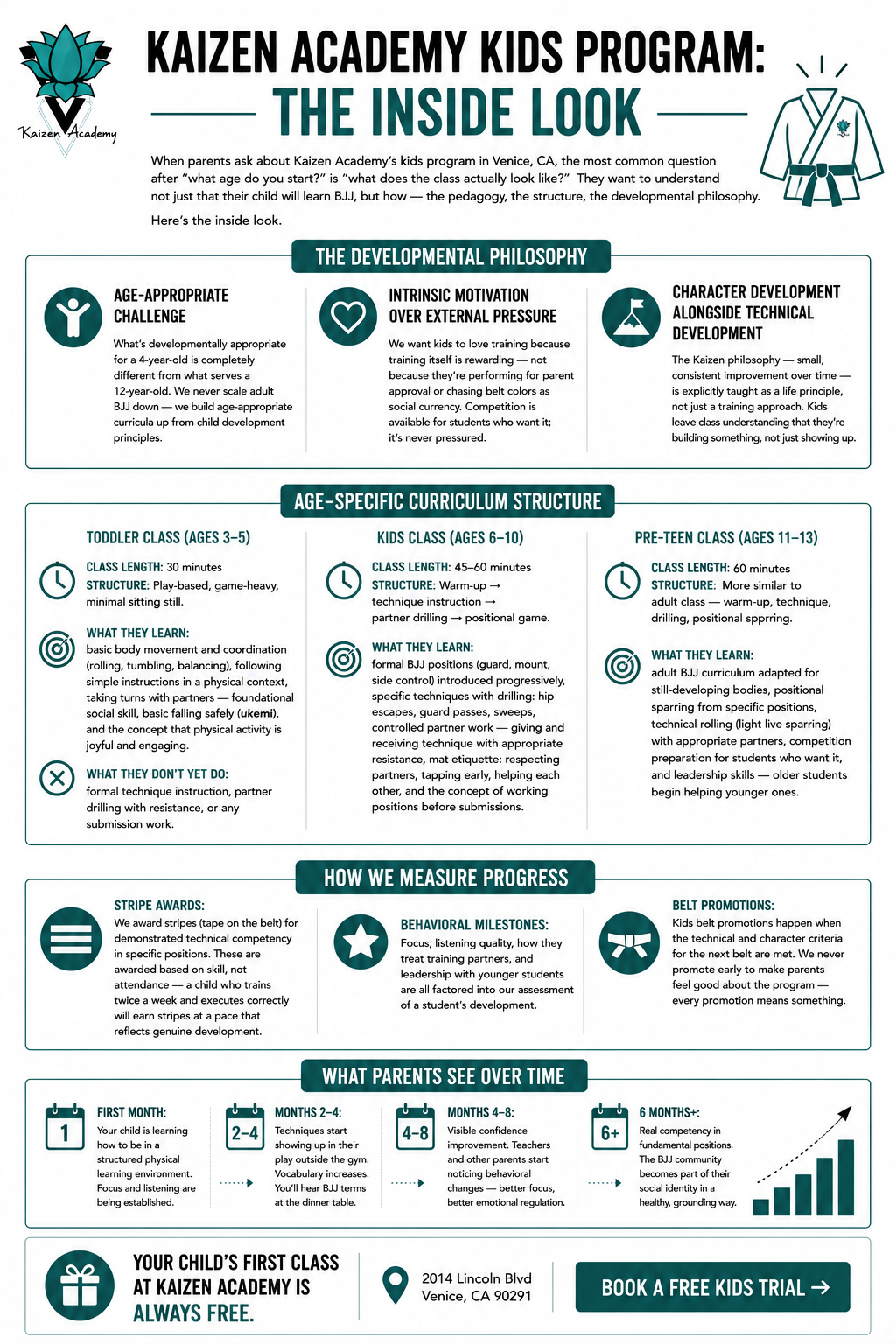

Parents considering enrolling their children in BJJ at Kaizen Academy in Venice, CA often want to understand the curriculum before committing. This post provides a detailed inside look at how Kaizen Academy structures kids BJJ instruction for ages 3–13 — the developmental philosophy, age-specific curriculum design, class structure, how progress is measured, and what parents can expect to see in their child over time.
When parents ask about Kaizen Academy's kids program in Venice, CA, the most common question after "what age do you start?" is "what does the class actually look like?" They want to understand not just that their child will learn BJJ, but how — the pedagogy, the structure, the developmental philosophy.
Here's the inside look.
Our kids program is built on three principles:
Age-appropriate challenge. What's developmentally appropriate for a 4-year-old is completely different from what serves a 12-year-old. We never scale adult BJJ down — we build age-appropriate curricula up from child development principles.
Intrinsic motivation over external pressure. We want kids to love training because training itself is rewarding — not because they're performing for parent approval or chasing belt colors as social currency. Competition is available for students who want it; it's never pressured.
Character development alongside technical development. The Kaizen philosophy — small, consistent improvement over time — is explicitly taught as a life principle, not just a training approach. Kids leave class understanding that they're building something, not just showing up.
Toddler Class (Ages 3–5)
Class length: 30 minutes. Structure: Play-based, game-heavy, minimal sitting still.
What they learn: basic body movement and coordination (rolling, tumbling, balancing), following simple instructions in a physical context, taking turns with partners — foundational social skill, basic falling safely (ukemi), and the concept that physical activity is joyful and engaging.
What they don't yet do: formal technique instruction, partner drilling with resistance, or any submission work.
Kids Class (Ages 6–10)
Class length: 45–60 minutes. Structure: Warm-up → technique instruction → partner drilling → positional game.
What they learn: formal BJJ positions (guard, mount, side control) introduced progressively, specific techniques with drilling: hip escapes, guard passes, sweeps, controlled partner work — giving and receiving technique with appropriate resistance, mat etiquette: respecting partners, tapping early, helping each other, and the concept of working positions before submissions.
Pre-Teen Class (Ages 11–13)
Class length: 60 minutes. Structure: More similar to adult class — warm-up, technique, drilling, positional sparring.
What they learn: adult BJJ curriculum adapted for still-developing bodies, positional sparring from specific positions, technical rolling (light live sparring) with appropriate partners, competition preparation for students who want it, and leadership skills — older students begin helping younger ones.
Stripe awards: We award stripes (tape on the belt) for demonstrated technical competency in specific positions. These are awarded based on skill, not attendance — a child who trains twice a week and executes correctly will earn stripes at a pace that reflects genuine development.
Behavioral milestones: Focus, listening quality, how they treat training partners, and leadership with younger students are all factored into our assessment of a student's development.
Belt promotions: Kids belt promotions happen when the technical and character criteria for the next belt are met. We never promote early to make parents feel good about the program — every promotion means something.
First month: Your child is learning how to be in a structured physical learning environment. Focus and listening are being established.
Months 2–4: Techniques start showing up in their play outside the gym. Vocabulary increases. You'll hear BJJ terms at the dinner table.
Months 4–8: Visible confidence improvement. Teachers and other parents start noticing behavioral changes — better focus, better emotional regulation.
6 months+: Real competency in fundamental positions. The BJJ community becomes part of their social identity in a healthy, grounding way.
Your child's first class at Kaizen Academy is always free. 2014 Lincoln Blvd, Venice, CA 90291.