How BJJ Changes Your Body After 6 Months — What to Expect
Six months of consistent BJJ training at Kaizen Academy in Venice, CA produces significant physical changes — here's what to realistically expect and when to expect it.
Six months of consistent BJJ training at Kaizen Academy in Venice, CA produces significant physical changes — here's what to realistically expect and when to expect it.
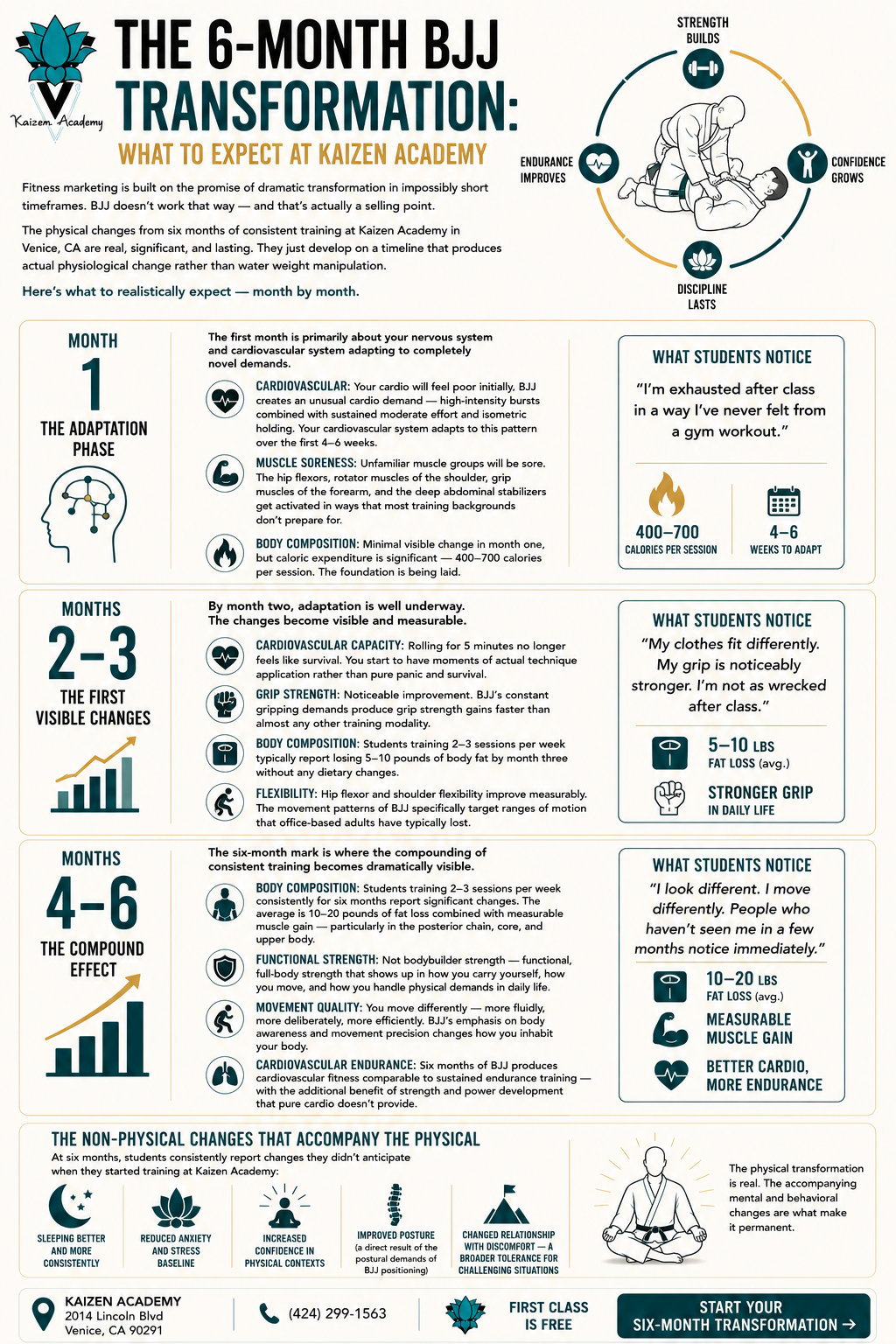

Most fitness programs promise dramatic physical transformation in 30 or 60 days. BJJ's physical changes are real but develop on a longer, more sustainable timeline. This post from Kaizen Academy in Venice, CA gives a detailed, honest account of the specific physical changes students experience at the 1-month, 3-month, and 6-month marks — covering body composition, strength, flexibility, cardiovascular capacity, and the changes students consistently report not expecting.
Fitness marketing is built on the promise of dramatic transformation in impossibly short timeframes. BJJ doesn't work that way — and that's actually a selling point.
The physical changes from six months of consistent training at Kaizen Academy in Venice, CA are real, significant, and lasting. They just develop on a timeline that produces actual physiological change rather than water weight manipulation.
Here's what to realistically expect — month by month.
The first month is primarily about your nervous system and cardiovascular system adapting to completely novel demands.
Cardiovascular: Your cardio will feel poor initially. BJJ creates an unusual cardio demand — high-intensity bursts combined with sustained moderate effort and isometric holding. Your cardiovascular system adapts to this pattern over the first 4–6 weeks.
Muscle soreness: Unfamiliar muscle groups will be sore. The hip flexors, rotator muscles of the shoulder, grip muscles of the forearm, and the deep abdominal stabilizers get activated in ways that most training backgrounds don't prepare for.
Body composition: Minimal visible change in month one, but caloric expenditure is significant — 400–700 calories per session. The foundation is being laid.
What students notice: "I'm exhausted after class in a way I've never felt from a gym workout."
By month two, adaptation is well underway. The changes become visible and measurable.
Cardiovascular capacity: Rolling for 5 minutes no longer feels like survival. You start to have moments of actual technique application rather than pure panic and survival.
Grip strength: Noticeable improvement. BJJ's constant gripping demands produce grip strength gains faster than almost any other training modality. Many students notice this in daily life — doors, jars, carrying things feel different.
Body composition: Students training 2–3 sessions per week typically report losing 5–10 pounds of body fat by month three without any dietary changes. The combination of caloric burn per session and improved metabolic rate creates a consistent deficit.
Flexibility: Hip flexor and shoulder flexibility improve measurably. The movement patterns of BJJ specifically target ranges of motion that office-based adults have typically lost.
What students notice: "My clothes fit differently. My grip is noticeably stronger. I'm not as wrecked after class."
The six-month mark is where the compounding of consistent training becomes dramatically visible.
Body composition: Students training 2–3 sessions per week consistently for six months report significant changes. The average is 10–20 pounds of fat loss combined with measurable muscle gain — particularly in the posterior chain, core, and upper body.
Functional strength: Not bodybuilder strength — functional, full-body strength that shows up in how you carry yourself, how you move, and how you handle physical demands in daily life.
Movement quality: This is the change that surprises students most. They move differently — more fluidly, more deliberately, more efficiently. BJJ's emphasis on body awareness and movement precision produces changes in how people inhabit their bodies that extend well beyond the mat.
Cardiovascular endurance: Six months of BJJ produces cardiovascular fitness comparable to sustained endurance training — with the additional benefit of strength and power development that pure cardio doesn't provide.
What students notice at 6 months: "I look different. I move differently. People who haven't seen me in a few months notice immediately."
At six months, students consistently report changes they didn't anticipate when they started training at Kaizen Academy:
The physical transformation is real. The accompanying mental and behavioral changes are what make it permanent.
Kaizen Academy is at 2014 Lincoln Blvd, Venice, CA 90291. First class is free.