How to Pick a Good Rolling Partner in BJJ
Your rolling partners shape your development more than almost any other variable in BJJ. Here's how to choose well at every stage of training at Kaizen Academy in Venice, CA.
Your rolling partners shape your development more than almost any other variable in BJJ. Here's how to choose well at every stage of training at Kaizen Academy in Venice, CA.
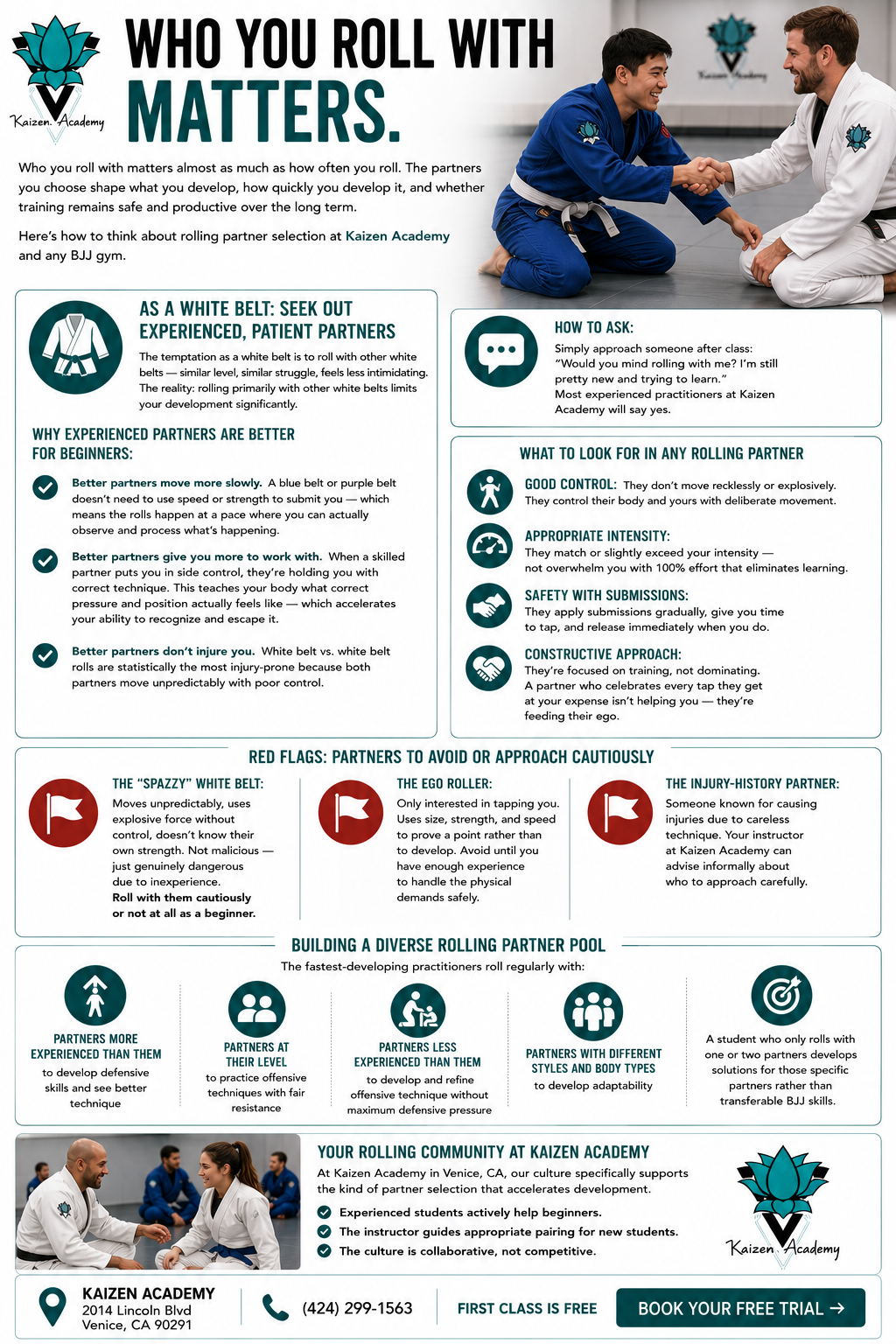

Rolling partner selection is one of the most underappreciated variables in BJJ development. The partners you choose — or avoid — at different stages of training have significant impact on how quickly you develop, what you develop, and how safe your training environment is. This guide from Kaizen Academy in Venice, CA covers how to think about rolling partner selection as a beginner, intermediate, and developing practitioner.
Who you roll with matters almost as much as how often you roll. The partners you choose shape what you develop, how quickly you develop it, and whether training remains safe and productive over the long term.
Here's how to think about rolling partner selection at Kaizen Academy and any BJJ gym.
The temptation as a white belt is to roll with other white belts — similar level, similar struggle, feels less intimidating. The reality: rolling primarily with other white belts limits your development significantly.
Why experienced partners are better for beginners:
Better partners move more slowly. A blue belt or purple belt doesn't need to use speed or strength to submit you — which means the rolls happen at a pace where you can actually observe and process what's happening.
Better partners give you more to work with. When a skilled partner puts you in side control, they're holding you with correct technique. This teaches your body what correct pressure and position actually feels like — which accelerates your ability to recognize and escape it.
Better partners don't injure you. White belt vs. white belt rolls are statistically the most injury-prone because both partners move unpredictably with poor control.
How to ask: Simply approach someone after class: "Would you mind rolling with me? I'm still pretty new and trying to learn." Most experienced practitioners at Kaizen Academy will say yes.
Good control: They don't move recklessly or explosively. They control their body and yours with deliberate movement.
Appropriate intensity: They match or slightly exceed your intensity — not overwhelm you with 100% effort that eliminates learning.
Safety with submissions: They apply submissions gradually, give you time to tap, and release immediately when you do.
Constructive approach: They're focused on training, not dominating. A partner who celebrates every tap they get at your expense isn't helping you — they're feeding their ego.
The "spazzy" white belt: Moves unpredictably, uses explosive force without control, doesn't know their own strength. Not malicious — just genuinely dangerous due to inexperience. Roll with them cautiously or not at all as a beginner.
The ego roller: Only interested in tapping you. Uses size, strength, and speed to prove a point rather than to develop. Avoid until you have enough experience to handle the physical demands safely.
The injury-history partner: Someone known for causing injuries due to careless technique. Your instructor at Kaizen Academy can advise informally about who to approach carefully.
The fastest-developing practitioners roll regularly with:
A student who only rolls with one or two partners develops solutions for those specific partners rather than transferable BJJ skills.
At Kaizen Academy in Venice, CA, our culture specifically supports the kind of partner selection that accelerates development. Experienced students actively help beginners. The instructor guides appropriate pairing for new students. The culture is collaborative, not competitive.
2014 Lincoln Blvd, Venice, CA 90291. First class is free.