How Kaizen Academy's Belt Promotion System Works — A Student's Guide
Everything you need to know about belt promotions at Kaizen Academy in Venice, CA — how they work, what instructors evaluate, and the mindset that produces the fastest development.
Everything you need to know about belt promotions at Kaizen Academy in Venice, CA — how they work, what instructors evaluate, and the mindset that produces the fastest development.
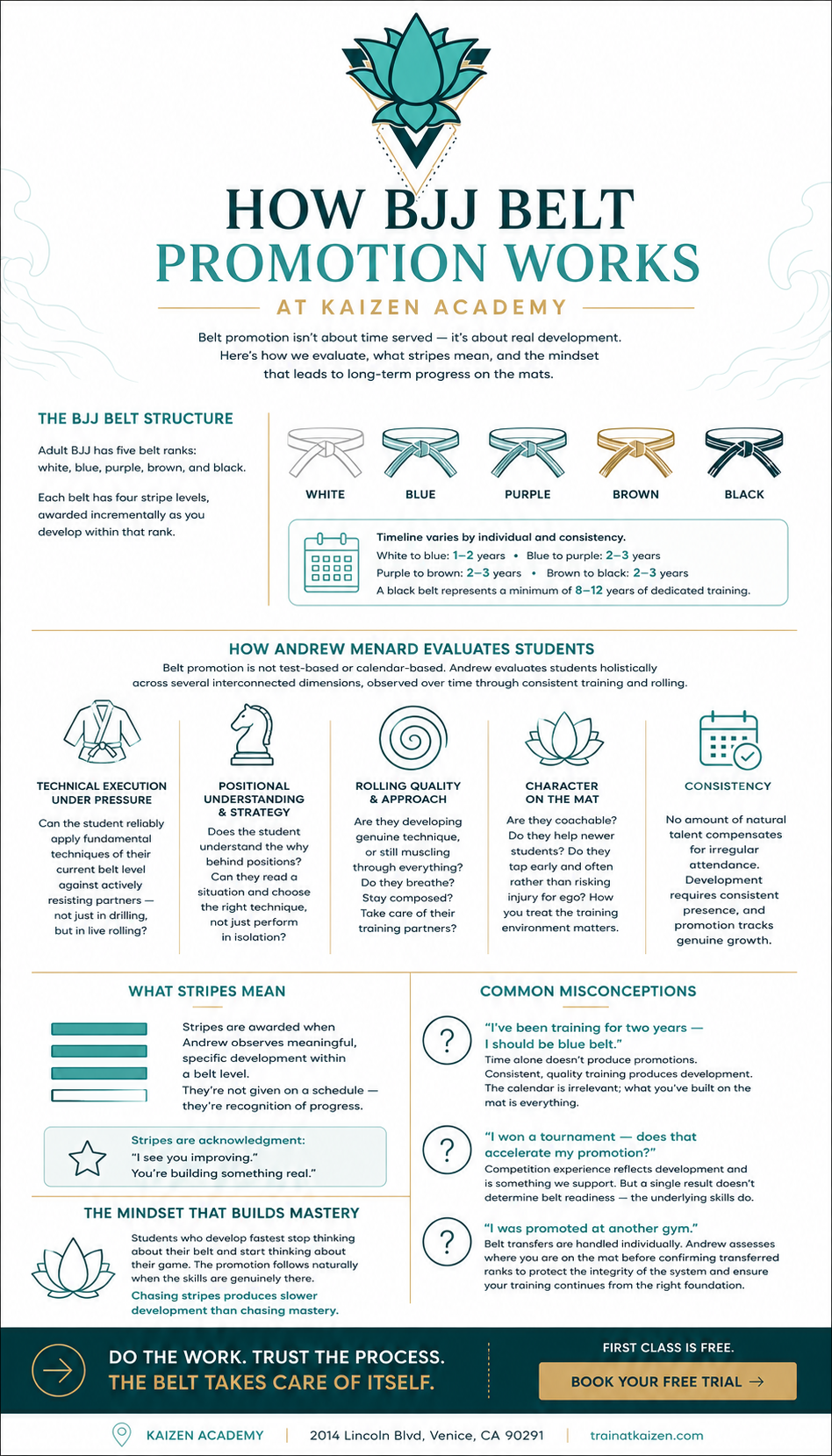

Belt promotion in BJJ is one of the most meaningful milestones in training — and one of the most misunderstood. This post explains exactly how Kaizen Academy in Venice, CA evaluates and promotes students, what each belt level represents, how the stripe system works, and the mindset that produces the fastest genuine development.
One of the most common questions new students at Kaizen Academy ask is: "How does belt promotion work here?" It's a fair question — and understanding the answer removes a lot of unnecessary anxiety about timelines and expectations. Here's the complete, honest picture.
Adult BJJ has five belt ranks: white, blue, purple, brown, and black. Each belt has four stripe levels, awarded incrementally as a practitioner develops within that rank. The stripe system provides visible milestones between major belt promotions and serves as an ongoing acknowledgment of progress.
Timeline between belts varies significantly by individual and consistency. White to blue typically takes 1–2 years of consistent training. Blue to purple takes another 2–3 years. Purple to brown and brown to black each require similar investment. A BJJ black belt represents a minimum of 8–12 years of dedicated training — one of the most difficult rank achievements in any martial art in the world.
At Kaizen Academy, belt promotion is not test-based or calendar-based. Head instructor Andrew Menard evaluates students holistically across several interconnected dimensions, observed over time through consistent attendance and rolling:
Technical execution under pressure. Can the student reliably apply the fundamental techniques of their current belt level against actively resisting partners — not just in drilling, but in live rolling against someone who knows what's coming?
Positional understanding and strategy. Does the student understand the why behind positions? Can they read a situation and recognize which technique is appropriate, or are they executing techniques in isolation without strategic context?
Rolling quality and approach. Are they developing genuine technique, or still muscling through everything? Do they breathe? Do they stay composed in bad positions? Do they take care of their training partners?
Character on the mat. Are they coachable? Do they help newer students? Do they tap early and often rather than risking injury for ego? How a student treats the training environment is part of their assessment at every level.
Consistency. No amount of natural talent compensates for irregular attendance. Development requires consistent presence, and promotion tracks genuine development.
Stripes are awarded when Andrew observes meaningful, specific development within a belt level. They're not given on a schedule — a student who trains three times per week with focused intent will earn stripes faster than one who attends irregularly without particular direction.
Stripes are acknowledgment: "I see you improving. You're building something real." They're recognition of progress, not a countdown timer to the next belt.
"I've been training for two years — I should be blue belt." Time alone doesn't produce promotions. Consistent, quality training produces development, and development produces promotions. The calendar is irrelevant; what you've built on the mat is everything.
"I won a tournament — does that accelerate my promotion?" Competition experience reflects development and is something Kaizen Academy actively supports. But a single tournament result doesn't determine belt readiness — what matters is whether the underlying skills that produced the win reflect the full curriculum for that level.
"I was promoted at another gym." Belt transfers are handled individually at Kaizen Academy. Andrew assesses where you are on the mat before confirming transferred ranks, which protects the integrity of the system and ensures your training continues from the correct foundation.
Students who develop fastest at Kaizen Academy share one characteristic: they stop thinking about their belt and start thinking about their game. The promotion follows naturally when the skills are genuinely there. Chasing stripes produces slower development than chasing mastery.
When students ask how to get promoted faster, the answer is always the same: show up more consistently, pay closer attention in class, drill with more intention, ask for specific feedback, and roll with partners who expose your weaknesses. Do those things, and the belt takes care of itself.
2014 Lincoln Blvd, Venice, CA 90291. First class is free.