How to Choose a BJJ Instructor: What to Look For (Venice, CA)
Choosing a BJJ instructor? What to look for — verified credentials, teaching quality, culture, and curriculum — from Kaizen Academy in Venice, CA.
Choosing a BJJ instructor? What to look for — verified credentials, teaching quality, culture, and curriculum — from Kaizen Academy in Venice, CA.
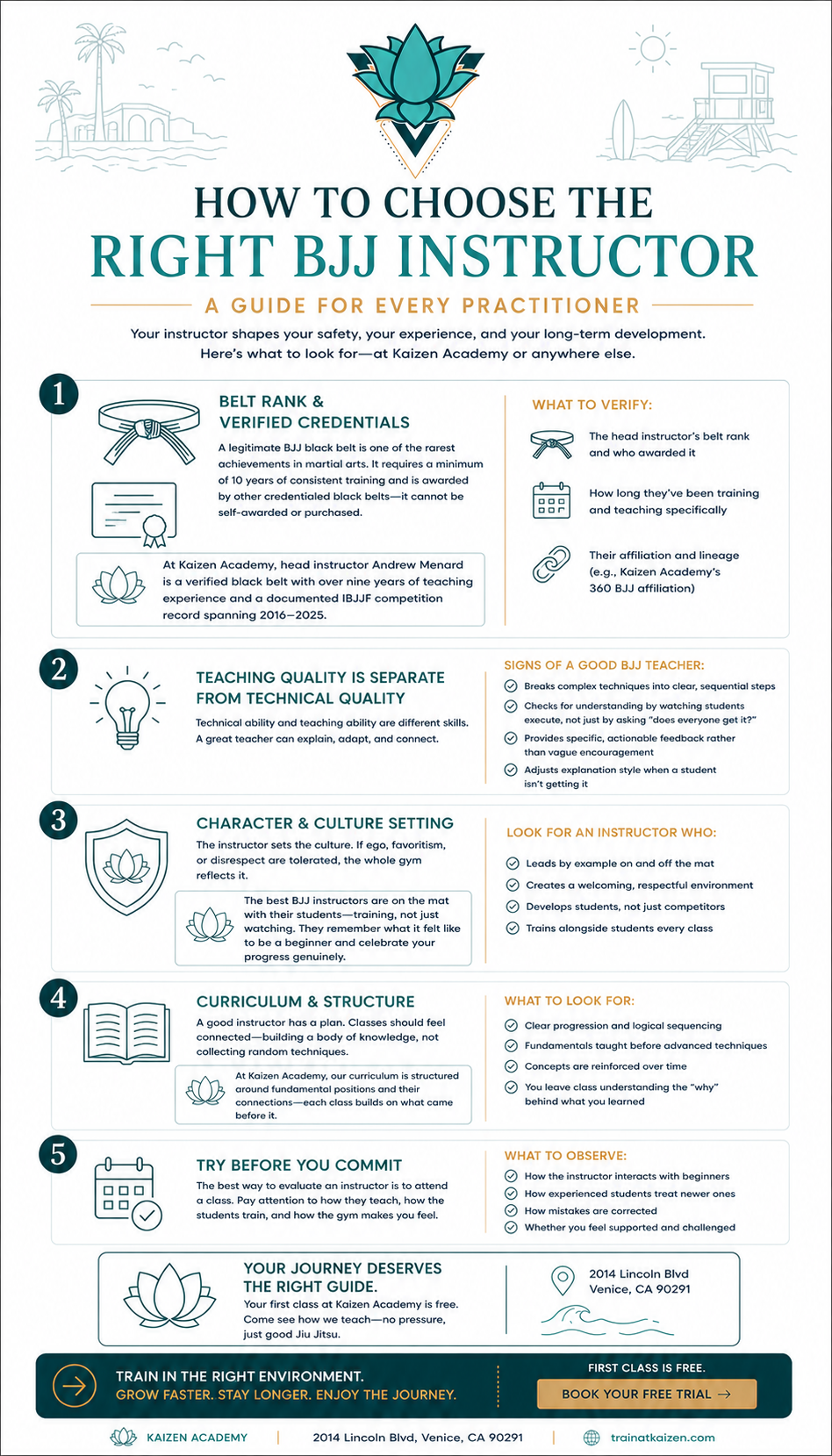

The quality of your BJJ instructor is the single most important variable in your development. This post covers what to look for in a BJJ professor — credentials, teaching style, curriculum structure, and character — and how Kaizen Academy in Venice, CA approaches instruction at every level.
When you step on the mat for the first time at any BJJ gym, you're placing your physical safety, your time, and your long-term development in the hands of the instructor. That relationship matters more than almost any other variable in your BJJ journey.
Here's how to evaluate whether an instructor — at Kaizen Academy or anywhere else — is the right fit for you.
A legitimate BJJ black belt is one of the rarest achievements in martial arts. It requires a minimum of 10 years of consistent training and is awarded by other credentialed black belts — it cannot be self-awarded or purchased.
When evaluating any gym, verify: the head instructor's belt rank and who awarded it; how long they've been training and teaching specifically; their affiliation — a recognized affiliation (like Kaizen Academy's 360 BJJ affiliation) provides a lineage chain that verifiable credentials attach to.
At Kaizen Academy, head instructor Andrew Menard is a verified black belt with over nine years of teaching experience and a documented IBJJF competition record spanning 2016–2025.
A black belt who cannot explain technique clearly, who cannot adapt instruction for different learning styles, or who teaches the same way to every student regardless of their needs — is not necessarily a good teacher. Technical ability and teaching ability are different skills.
Signs of a good BJJ teacher: breaks complex techniques into clear, sequential steps; checks for understanding by watching students execute, not just by asking "does everyone get it?"; provides specific, actionable feedback rather than vague encouragement; adjusts explanation style when a student isn't getting it.
The instructor sets the culture of the gym. If the instructor tolerates ego-driven training, disrespects students, plays favorites, or creates a hierarchical environment where newer students feel unwelcome — the entire gym will reflect that.
The best BJJ instructors are on the mat with their students, not coaching from a chair. They remember what it felt like to be a beginner. They celebrate their students' progress genuinely. At Kaizen Academy, you'll find Andrew on the mat every class — training alongside students, not observing from a distance.
A good instructor has a plan. Classes should feel connected — like you're building a body of knowledge, not collecting random techniques. If every class feels like a completely disconnected collection of moves with no clear pedagogical direction, that's a sign of insufficient curriculum development.
At Kaizen Academy, our curriculum is structured around fundamental positions and their connections — each class builds on what came before it.
If you're looking for a structured starting point, our beginner BJJ classes are designed for students with no prior experience, and you can check the current class schedule before visiting.
The best way to evaluate an instructor is to attend a class. Watch how they interact with beginners. Watch how experienced students treat newer ones. Watch whether the instructor corrects mistakes with encouragement or criticism.
Your first class at Kaizen Academy is free. Come see how we teach before making any decisions.
2014 Lincoln Blvd, Venice, CA 90291.