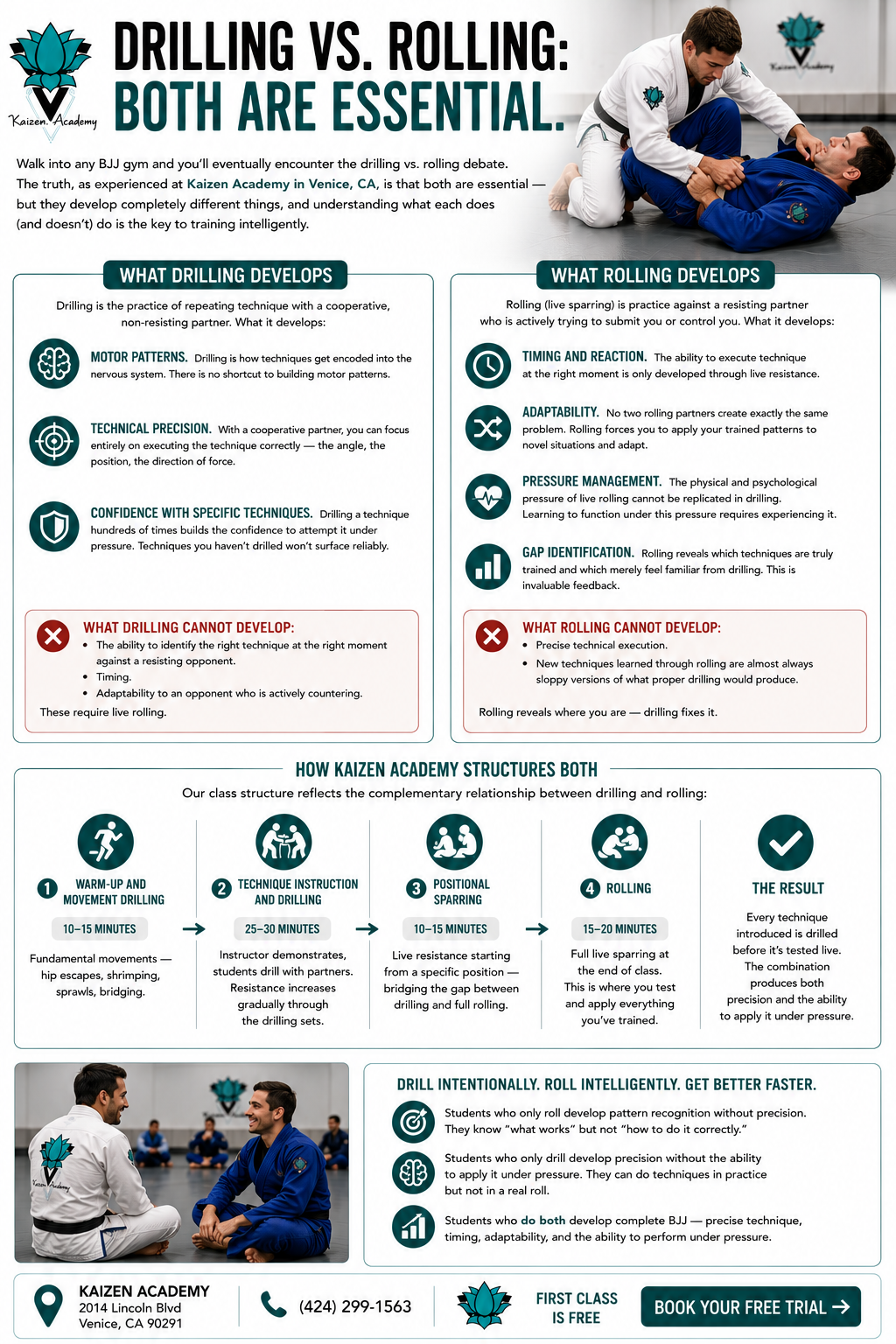
Walk into any BJJ gym and you'll eventually encounter the drilling vs. rolling debate. On one side: practitioners who believe drilling is the foundation of everything and that beginners should drill thousands of reps before significant live rolling. On the other: those who believe you only really learn BJJ by rolling and that drilling is just exercise.
The truth, as experienced at Kaizen Academy in Venice, CA, is that both are essential — but they develop completely different things, and understanding what each does (and doesn't) do is the key to training intelligently.
What Drilling Develops
Drilling is the practice of repeating technique with a cooperative, non-resisting partner. What it develops:
Motor patterns. Drilling is how techniques get encoded into the nervous system. The pathways that allow you to execute a technique without consciously thinking about each step are built through repetition. This is not negotiable — there is no shortcut to building motor patterns.
Technical precision. With a cooperative partner, you can focus entirely on executing the technique correctly — the angle of the hip, the position of the elbow, the direction of force. Under live rolling pressure, this level of attention to detail is impossible.
Confidence with specific techniques. Drilling a technique hundreds of times builds the confidence to attempt it under pressure. Techniques you haven't drilled extensively will not surface reliably in live rolling.
What drilling cannot develop: The ability to identify the right technique at the right moment against a resisting opponent. Timing. Adaptability to an opponent who is actively countering. These require live rolling.
What Rolling Develops
Rolling (live sparring) is practice against a resisting partner who is actively trying to submit you or control you. What it develops:
Timing and reaction. The ability to execute technique at the right moment — when the opening exists and not before or after — is only developed through live resistance.
Adaptability. No two rolling partners create exactly the same problem. Rolling forces you to apply your trained patterns to novel situations and adapt when they don't work as expected.
Pressure management. The physical and psychological pressure of live rolling — the heart rate elevation, the cognitive load, the stakes — cannot be replicated in drilling. Learning to function under this pressure requires experiencing it.
Gap identification. Rolling reveals which techniques are truly trained and which merely feel familiar from drilling. This is invaluable feedback.
What rolling cannot develop: Precise technical execution. New techniques learned through rolling are almost always sloppy versions of what proper drilling would produce. Rolling reveals where you are — drilling fixes it.
How Kaizen Academy Structures Both
At Kaizen Academy, our class structure reflects the complementary relationship between drilling and rolling:
- Warm-up and movement drilling: 10–15 minutes of fundamental movements — hip escapes, shrimping, sprawls, bridging.
- Technique instruction and drilling: 25–30 minutes. Instructor demonstrates, students drill with partners. Resistance increases gradually through the drilling sets.
- Positional sparring: 10–15 minutes. Live resistance starting from a specific position — bridging the gap between drilling and full rolling.
- Rolling: 15–20 minutes of full live sparring at the end of class.
This structure ensures that every technique introduced is drilled before it's tested live. Students who only roll develop pattern recognition without precision. Students who only drill develop precision without the ability to apply it under pressure. The combination produces both.
Kaizen Academy is at 2014 Lincoln Blvd, Venice, CA 90291. First class is free.
Book your free trial →