The Mental Game of BJJ — How to Stay Calm Under Pressure
Physical technique without mental composure is incomplete BJJ. Here's how Kaizen Academy in Venice, CA develops the mental skills that make the difference under pressure.
Physical technique without mental composure is incomplete BJJ. Here's how Kaizen Academy in Venice, CA develops the mental skills that make the difference under pressure.
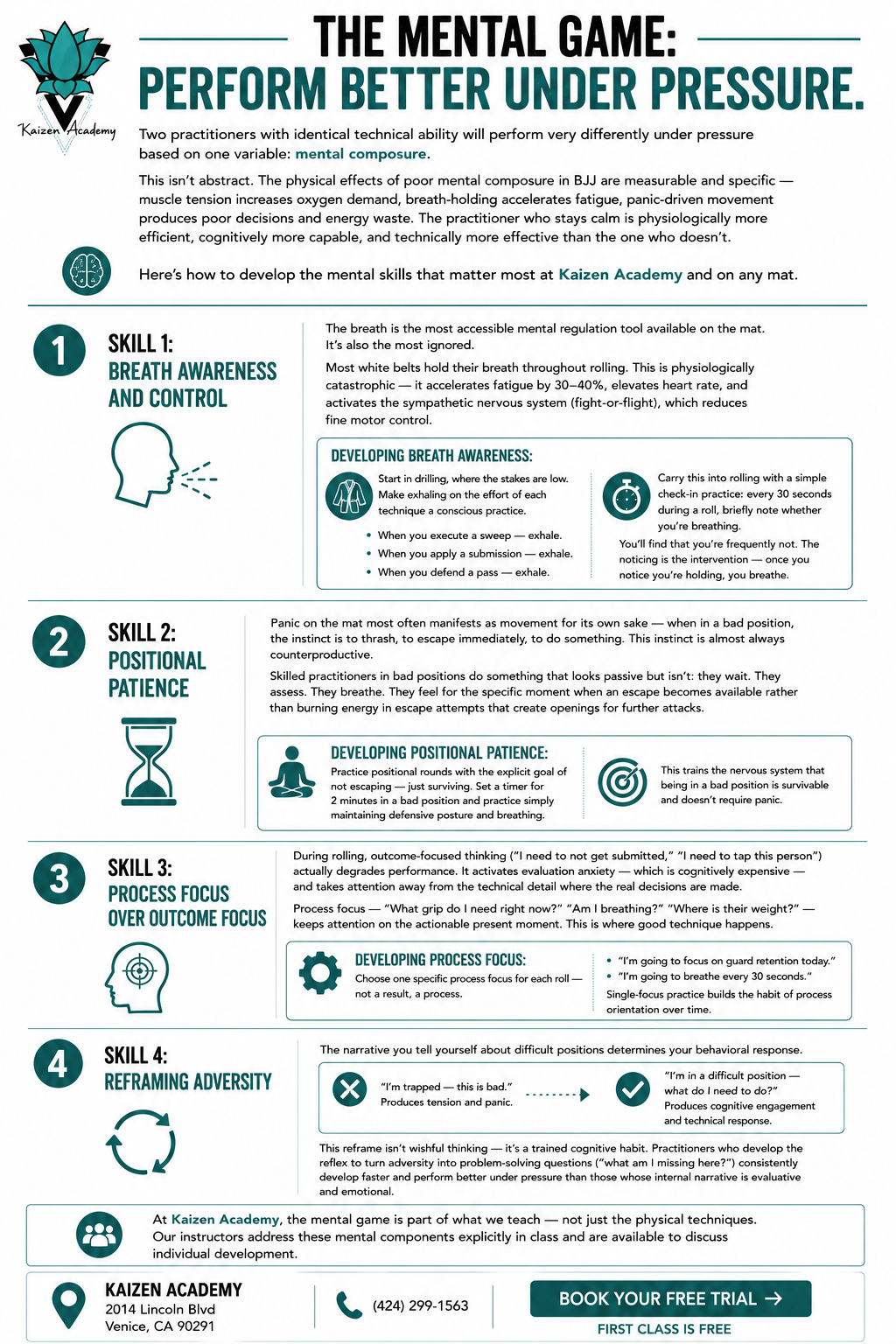

BJJ's physical demands get most of the attention — technique, conditioning, flexibility. But the mental game is where most practitioners have the largest undeveloped capacity. This post from Kaizen Academy in Venice, CA identifies the specific mental skills that determine BJJ performance under pressure — composure, breath control, positional patience, and process focus — and provides practical approaches for developing each one.
Two practitioners with identical technical ability will perform very differently under pressure based on one variable: mental composure.
This isn't abstract. The physical effects of poor mental composure in BJJ are measurable and specific — muscle tension increases oxygen demand, breath-holding accelerates fatigue, panic-driven movement produces poor decisions and energy waste. The practitioner who stays calm is physiologically more efficient, cognitively more capable, and technically more effective than the one who doesn't.
Here's how to develop the mental skills that matter most at Kaizen Academy and on any mat.
The breath is the most accessible mental regulation tool available on the mat. It's also the most ignored.
Most white belts hold their breath throughout rolling. This is physiologically catastrophic — it accelerates fatigue by 30–40%, elevates heart rate, and activates the sympathetic nervous system (fight-or-flight), which reduces fine motor control.
Developing breath awareness:
Start in drilling, where the stakes are low. Make exhaling on the effort of each technique a conscious practice. When you execute a sweep — exhale. When you apply a submission — exhale. When you defend a pass — exhale.
Carry this into rolling with a simple check-in practice: every 30 seconds during a roll, briefly note whether you're breathing. You'll find that you're frequently not. The noticing is the intervention — once you notice you're holding, you breathe.
Panic on the mat most often manifests as movement for its own sake — when in a bad position, the instinct is to thrash, to escape immediately, to do something. This instinct is almost always counterproductive.
Skilled practitioners in bad positions do something that looks passive but isn't: they wait. They assess. They breathe. They feel for the specific moment when an escape becomes available rather than burning energy in escape attempts that create openings for further attacks.
Developing positional patience:
Practice positional rounds with the explicit goal of not escaping — just surviving. Set a timer for 2 minutes in a bad position and practice simply maintaining defensive posture and breathing. This trains the nervous system that being in a bad position is survivable and doesn't require panic.
During rolling, outcome-focused thinking ("I need to not get submitted," "I need to tap this person") actually degrades performance. It activates evaluation anxiety — which is cognitively expensive — and takes attention away from the technical detail where the real decisions are made.
Process focus — "What grip do I need right now?" "Am I breathing?" "Where is their weight?" — keeps attention on the actionable present moment. This is where good technique happens.
Developing process focus:
Choose one specific process focus for each roll — not a result, a process. "I'm going to focus on guard retention today." "I'm going to breathe every 30 seconds." Single-focus practice builds the habit of process orientation over time.
The narrative you tell yourself about difficult positions determines your behavioral response. "I'm trapped — this is bad" produces tension and panic. "I'm in a difficult position — what do I need to do?" produces cognitive engagement and technical response.
This reframe isn't wishful thinking — it's a trained cognitive habit. Practitioners who develop the reflex to turn adversity into problem-solving questions ("what am I missing here?") consistently develop faster and perform better under pressure than those whose internal narrative is evaluative and emotional.
At Kaizen Academy, the mental game is part of what we teach — not just the physical techniques. Our instructors address these mental components explicitly in class and are available to discuss individual development.
Kaizen Academy is at 2014 Lincoln Blvd, Venice, CA 90291. First class is free.