Mount Position in BJJ: What It Is & How It Works
Learn what the mount position is in Brazilian Jiu Jitsu, why it is so dominant, how to maintain it, common submissions, and how to escape mount.
Learn what the mount position is in Brazilian Jiu Jitsu, why it is so dominant, how to maintain it, common submissions, and how to escape mount.

Learn what the mount position is in Brazilian Jiu Jitsu, why it is so dominant, how to maintain it, common submissions, and how to escape mount.
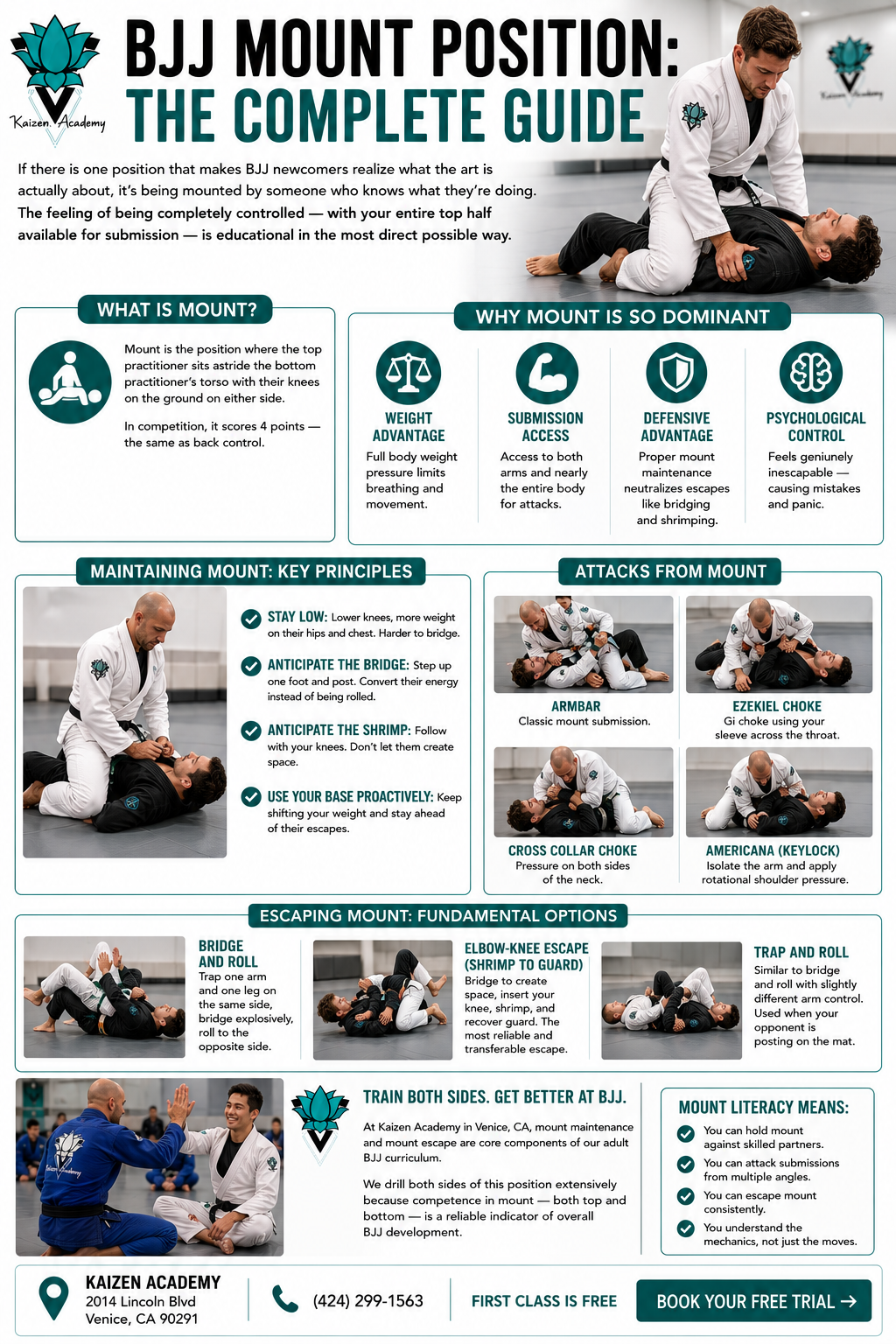
If there is one position that makes BJJ newcomers realize what the art is actually about, it's being mounted by someone who knows what they're doing. The feeling of being completely controlled — with your entire top half available for submission — is educational in the most direct possible way.
Understanding mount — from both top and bottom — is essential BJJ literacy. Here's the complete guide.
Mount is the position where the top practitioner sits astride the bottom practitioner's torso with their knees on the ground on either side. In competition, it scores 4 points — the same as back control — reflecting its genuinely dominant nature.
Unlike side control, where the bottom person has significant escape options, a well-maintained mount severely limits escape routes and exposes nearly the entire body to submission attack.
From mount, the top practitioner has:
Full weight distribution advantage. Their entire body weight can be concentrated on the bottom person's chest and hips, limiting breathing and movement.
Submission access to both arms. Unlike back control (where attacks are primarily chokes) or side control (where arm access is limited), mount provides access to both arms simultaneously.
Defensive structural advantage. The bottom person's strongest escapes — bridging and shrimping — require significant hip movement that proper mount maintenance can neutralize.
Psychological pressure. Being mounted by a skilled practitioner feels genuinely inescapable in a way that side control doesn't. This psychological pressure causes many bottom players to make mistake-driven decisions.
The most common beginner mistake in mount is sitting statically and waiting. Skilled opponents will escape static mount. Mount maintenance is active and adaptive.
Stay low. A high mount (sitting upright with your knees high on their chest) looks dominant but is easy to bridge and roll. A low mount (knees lower, more of your weight distributed) is harder to bridge.
Anticipate the bridge. When your partner bridges (thrusts their hips up), step up one foot and \"post\" — converting the energy of the bridge rather than being rolled by it.
Anticipate the shrimp. When your partner shrimps (moves their hips sideways), follow them with your knees rather than letting them create space between your body and theirs.
Use your base proactively. Don't wait to be moved — keep your weight shifting slightly before your partner has fully committed to an escape.
The Armbar: Classic mount submission. Control one arm, swing your leg across the face, hip up and extend.
The Ezekiel Choke: A gi-specific choke applied with your own sleeve, driving across the throat from mount. Particularly useful when your opponent's arms are trapped defending.
The Cross Collar Choke: Using both lapels from mount to apply pressure on both sides of the neck simultaneously.
The Americana (Keylock): Isolate one arm bent at 90 degrees and apply rotational shoulder pressure. High percentage from mount when the opponent is defending with bent arms.
The Bridge and Roll: Trap one arm and one leg on the same side, bridge explosively, roll to the opposite side. Works best when the top person is heavy on one side.
The Elbow-Knee Escape (Shrimp to Guard): Create space with a bridge, insert your knee between you and your opponent, shrimp to create more space, recover guard. The most reliable and transferable mount escape.
The Trap and Roll: Similar to bridge and roll with slightly different arm control. Used when the opponent is posting their hands on the mat.
At Kaizen Academy in Venice, CA, mount maintenance and mount escape are core components of our adult BJJ curriculum. For beginners, these fundamentals are built into our beginner BJJ classes and practiced progressively with live partners.
When you're ready to train these positions in person, view the current BJJ class schedule or learn more about BJJ in Venice, CA.