Rear Naked Choke (RNC): What It Is & How It Works in BJJ
Learn what the rear naked choke is, how it works from back control, why it is so effective, and how to train the RNC safely in BJJ.
Learn what the rear naked choke is, how it works from back control, why it is so effective, and how to train the RNC safely in BJJ.

Learn what the rear naked choke is, how it works from back control, why it is so effective, and how to train the RNC safely in BJJ.
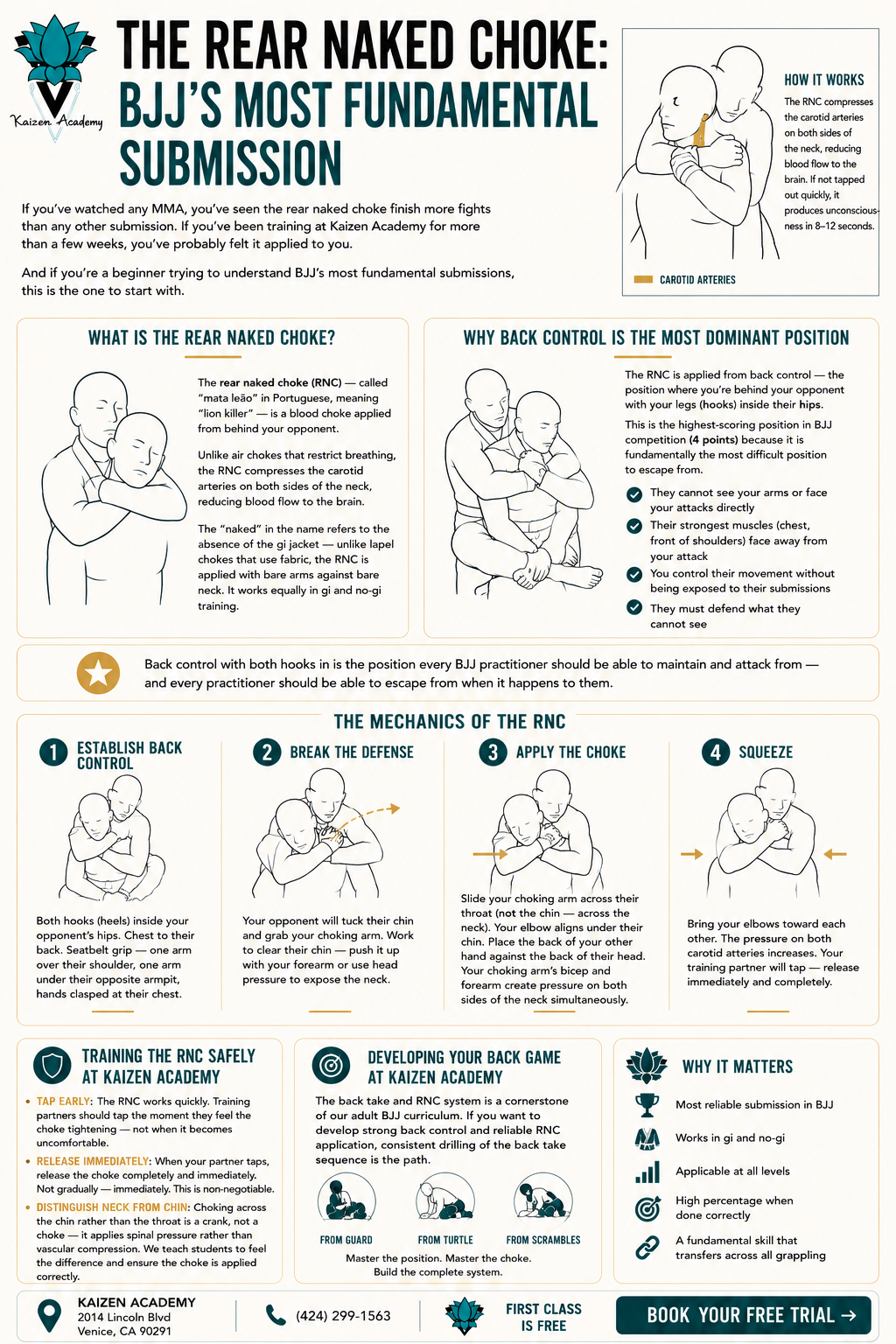
If you've watched any MMA, you've seen the rear naked choke finish more fights than any other submission. If you've been training at Kaizen Academy for more than a few weeks, you've probably felt it applied to you. And if you're a beginner trying to understand BJJ's most fundamental submissions, this is the one to start with.
The rear naked choke (RNC) — called \"mata leão\" in Portuguese, meaning \"lion killer\" — is a blood choke applied from behind your opponent. Unlike air chokes that restrict breathing, the RNC compresses the carotid arteries on both sides of the neck, reducing blood flow to the brain. If not tapped out of quickly, it produces unconsciousness in 8–12 seconds.
The \"naked\" in the name refers to the absence of the gi jacket — unlike lapel chokes that use fabric, the RNC is applied with bare arms against bare neck. It works equally in gi and no-gi training.
The RNC is applied from back control — the position where you're behind your opponent with your legs (hooks) inside their hips. This is the highest-scoring position in BJJ competition (4 points) because it is fundamentally the most difficult position to escape from.
When you have someone's back:
Back control with both hooks in is the position every BJJ practitioner should be able to maintain and attack from — and every practitioner should be able to escape from when it happens to them.
Step 1: Establish back control. Both hooks (heels) inside your opponent's hips. Chest to their back. Seatbelt grip — one arm over their shoulder, one arm under their opposite armpit, hands clasped at their chest.
Step 2: Break the defense. Your opponent will tuck their chin and grab your choking arm. Work to clear their chin — push it up with your forearm or use head pressure to expose the neck.
Step 3: Apply the choke. Slide your choking arm across their throat (not the chin — across the neck). Your elbow aligns under their chin. Place the back of your other hand against the back of their head. Your choking arm's bicep and forearm create pressure on both sides of the neck simultaneously.
Step 4: Squeeze. Bring your elbows toward each other. The pressure on both carotid arteries increases. Your training partner will tap — release immediately and completely.
At Kaizen Academy, we teach the RNC with specific emphasis on:
Tap early. The RNC works quickly. Training partners should tap the moment they feel the choke tightening — not when it becomes uncomfortable.
Release immediately. When your partner taps, release the choke completely and immediately. Not gradually — immediately. This is non-negotiable.
Distinguish neck from chin. Choking across the chin rather than the throat is a crank, not a choke — it applies spinal pressure rather than vascular compression. We teach students to feel the difference and ensure the choke is applied correctly.
The back take and RNC system is a cornerstone of our adult BJJ curriculum. Beginners can learn the position and submission progressively in our beginner BJJ classes, with an emphasis on controlled drilling and safe tapping.
When you're ready to train consistently, view the current BJJ class schedule or learn more about BJJ in Venice, CA.