Triangle Choke in BJJ: What It Is & How It Works
Learn what a triangle choke is, how it works, common setups and mistakes, and why it is one of the most effective BJJ submissions.
Learn what a triangle choke is, how it works, common setups and mistakes, and why it is one of the most effective BJJ submissions.

Learn what a triangle choke is, how it works, common setups and mistakes, and why it is one of the most effective BJJ submissions.
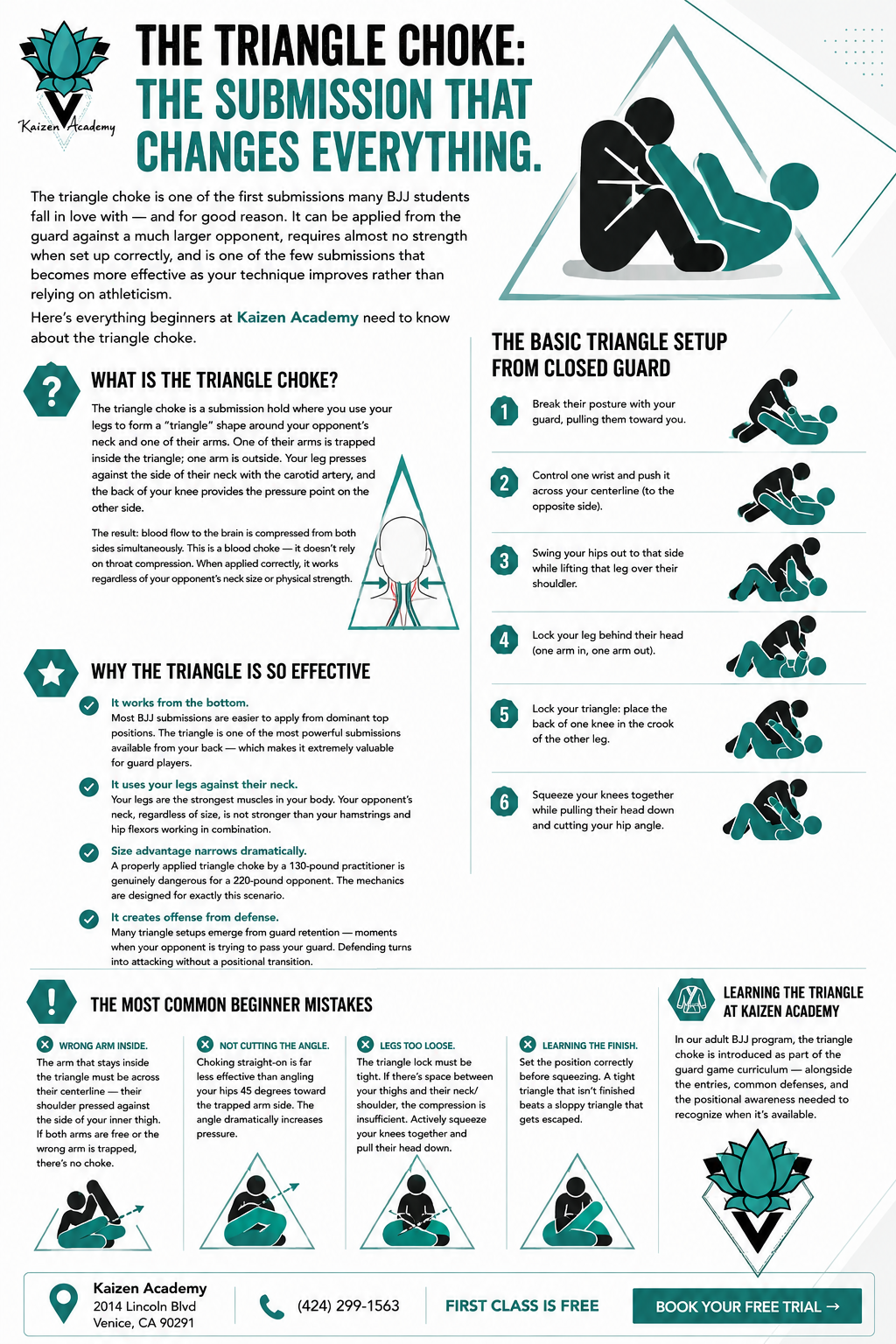
The triangle choke is one of the first submissions many BJJ students fall in love with — and for good reason. It can be applied from the guard against a much larger opponent, requires almost no strength when set up correctly, and is one of the few submissions that becomes more effective as your technique improves rather than relying on athleticism.
Here's everything beginners at Kaizen Academy need to know about the triangle choke.
The triangle choke is a submission hold where you use your legs to form a "triangle" shape around your opponent's neck and one of their arms. One of their arms is trapped inside the triangle; one arm is outside. Your leg presses against the side of their neck with the carotid artery, and the back of your knee provides the pressure point on the other side.
The result: blood flow to the brain is compressed from both sides simultaneously. This is a blood choke — it doesn't rely on throat compression. When applied correctly, it works regardless of your opponent's neck size or physical strength.
It works from the bottom. Most BJJ submissions are easier to apply from dominant top positions. The triangle is one of the most powerful submissions available from your back — which makes it extremely valuable for guard players.
It uses your legs against their neck. Your legs are the strongest muscles in your body. Your opponent's neck, regardless of size, is not stronger than your hamstrings and hip flexors working in combination.
Size advantage narrows dramatically. A properly applied triangle choke by a 130-pound practitioner is genuinely dangerous for a 220-pound opponent. The mechanics are designed for exactly this scenario.
It creates offense from defense. Many triangle setups emerge from guard retention — moments when your opponent is trying to pass your guard. Defending turns into attacking without a positional transition.
The most common entry is from closed guard when your opponent posts one hand on your chest or reaches forward:
Wrong arm inside. The arm that stays inside the triangle must be across their centerline — their shoulder pressed against the side of your inner thigh. If both arms are free or the wrong arm is trapped, there's no choke.
Not cutting the angle. Choking straight-on is far less effective than angling your hips 45 degrees toward the trapped arm side. The angle dramatically increases pressure.
Legs too loose. The triangle lock must be tight. If there's space between your thighs and their neck/shoulder, the compression is insufficient. Actively squeeze your knees together and pull their head down.
Rushing the finish. Set the position correctly before squeezing. A tight triangle that isn't finished beats a sloppy triangle that gets escaped.
In our adult BJJ program, the triangle choke is introduced as part of the guard game curriculum — alongside the entries, common defenses, and the positional awareness needed to recognize when it's available.
Kaizen Academy is at 2014 Lincoln Blvd, Venice, CA 90291. First class is free.