If there's one submission that represents BJJ in popular culture, it's the armbar. Seen in UFC finishes, action movies, and police use-of-force scenarios worldwide, the armbar is both iconic and genuinely effective. But many beginners who've seen it don't fully understand how and why it works.
Here's the complete beginner's guide.
What Is an Armbar?
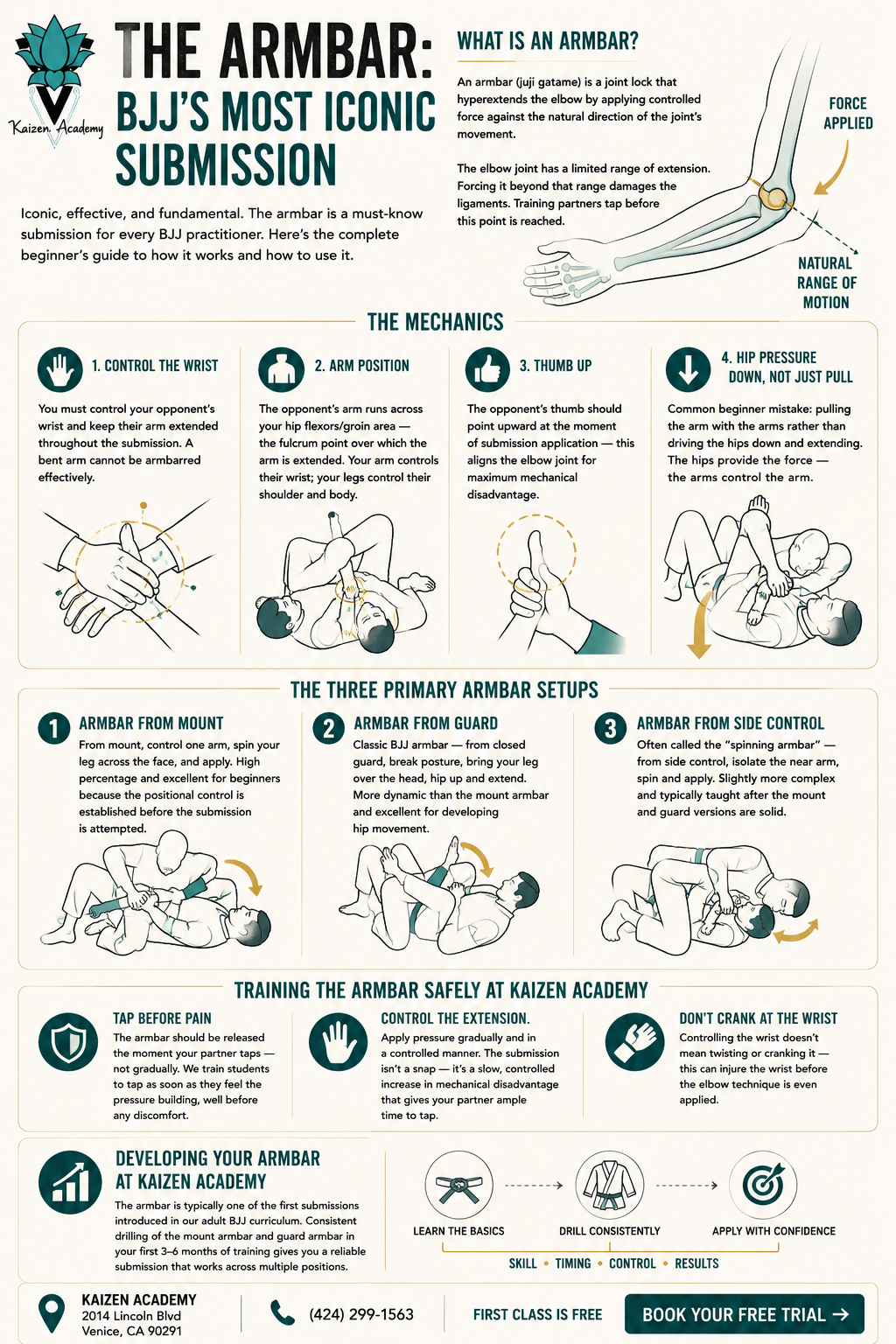
An armbar (also called "juji gatame" in judo terminology) is a joint lock that hyperextends the elbow by applying controlled force against the natural direction of the joint's movement. Applied correctly, it creates a mechanical disadvantage that forces the opponent to submit before the joint is damaged.
The submission works because the elbow joint has a limited range of extension — it's designed to bend in one direction only. Forcing it beyond that range damages the ligaments of the elbow. Training partners tap before this point is reached.
The Mechanics
The key elements of an effective armbar:
Control the wrist. You must control your opponent's wrist and keep their arm extended throughout the submission. A bent arm cannot be armbarred effectively.
Arm position. The opponent's arm runs across your hip flexors/groin area — the fulcrum point over which the arm is extended. Your arm controls their wrist; your legs control their shoulder and body.
Thumb up. The opponent's thumb should point upward at the moment of submission application — this aligns the elbow joint for maximum mechanical disadvantage.
Hip pressure down, not just pull. Common beginner mistake: pulling the arm with the arms rather than driving the hips down and extending. The hips provide the force — the arms control the arm.
The Three Primary Armbar Setups
Armbar from Mount: One of the first submissions taught at Kaizen Academy. From mount, control one arm, spin your leg across the face, and apply. High percentage and excellent for beginners because the positional control is established before the submission is attempted.
Armbar from Guard: Classic BJJ armbar — from closed guard, break posture, bring your leg over the head, hip up and extend. More dynamic than the mount armbar and excellent for developing hip movement.
Armbar from Side Control: Often called the "spinning armbar" — from side control, isolate the near arm, spin and apply. Slightly more complex and typically taught after the mount and guard versions are solid.
Training the Armbar Safely at Kaizen Academy
At Kaizen Academy, we teach the armbar with specific safety emphasis:
Tap before pain. The armbar should be released the moment your partner taps — not gradually. We train students to tap as soon as they feel the pressure building, well before any discomfort.
Control the extension. Apply pressure gradually and in a controlled manner. The submission isn't a snap — it's a slow, controlled increase in mechanical disadvantage that gives your partner ample time to tap.
Don't crank at the wrist. Controlling the wrist doesn't mean twisting or cranking it — this can injure the wrist before the elbow technique is even applied.
Developing Your Armbar at Kaizen Academy
The armbar is typically one of the first submissions introduced in our adult BJJ curriculum. Consistent drilling of the mount armbar and guard armbar in your first 3–6 months of training gives you a reliable submission that works across multiple positions. It also pairs naturally with the triangle choke, which attacks from the same guard positions.
Kaizen Academy is at 2014 Lincoln Blvd, Venice, CA 90291. First class is free.
Book your free trial →