What Is Guard in BJJ? Complete Guide to BJJ Guard Positions
Learn what guard means in Brazilian Jiu Jitsu, the major BJJ guard positions, how guard works, and why it is one of the most important positions for beginners.
Learn what guard means in Brazilian Jiu Jitsu, the major BJJ guard positions, how guard works, and why it is one of the most important positions for beginners.

Learn what guard means in Brazilian Jiu Jitsu, the major BJJ guard positions, how guard works, and why it is one of the most important positions for beginners.
One of the most confusing concepts for people new to BJJ is the idea that being on the bottom — with someone on top of you — can actually be an advantageous position. In every other fighting context, being taken to the ground and pinned feels like losing.
In BJJ, it's where some of the most powerful techniques in the art live.
Understanding guard is understanding what makes BJJ unique. Here's the complete beginner's guide.
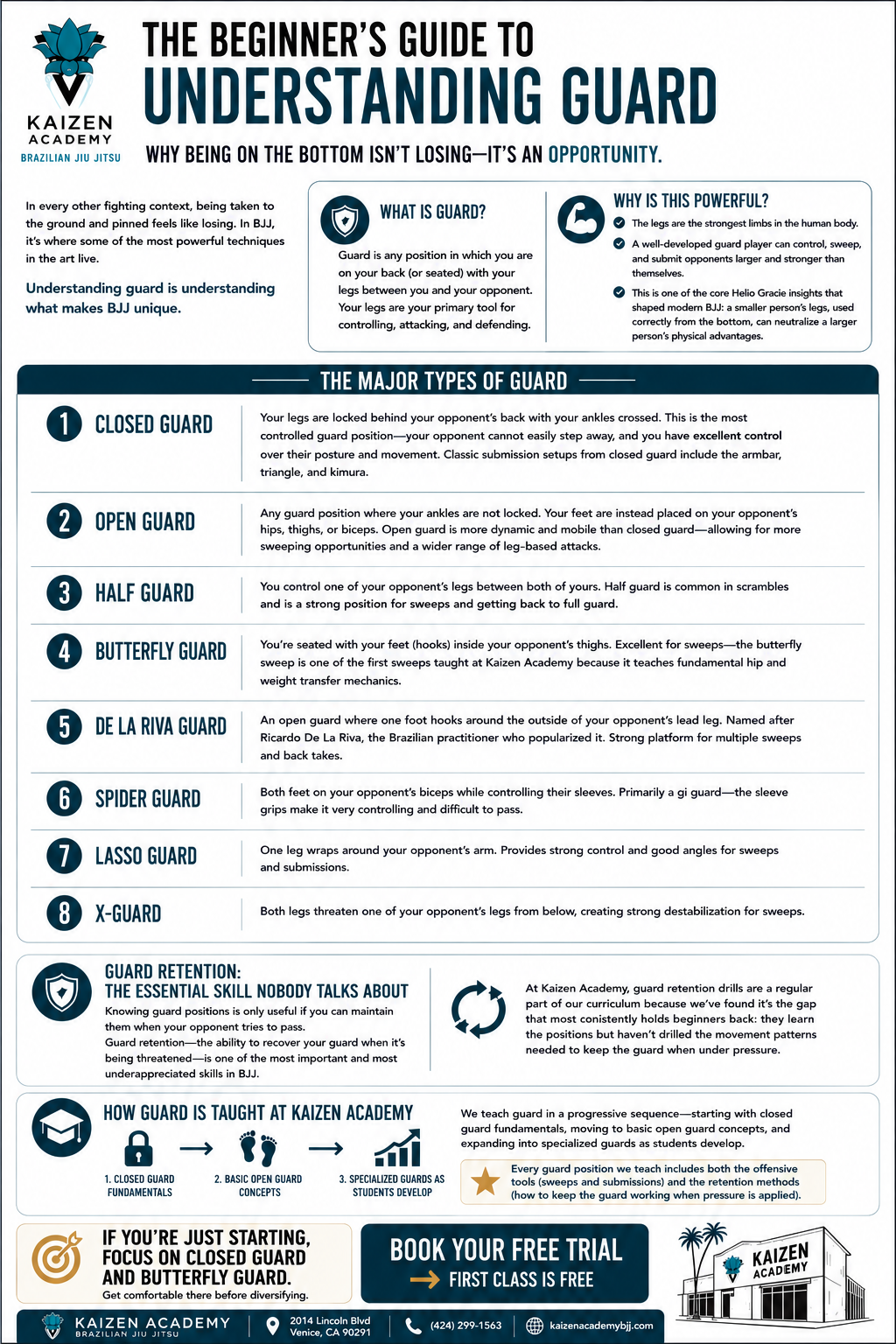
Guard is any position in which you are on your back (or seated) with your legs between you and your opponent. The defining characteristic of guard is that your legs are your primary tool for controlling, attacking, and defending.
Why is this powerful? Because the legs are the strongest limbs in the human body — and in guard, you're using your strongest tools against your opponent's upper body. A well-developed guard player can control, sweep, and submit opponents significantly larger and stronger than themselves.
This is one of the core Helio Gracie insights that shaped modern BJJ: a smaller person's legs, used correctly from the bottom position, can neutralize a larger person's physical advantages.
Closed Guard: Your legs are locked behind your opponent's back with your ankles crossed. This is the most controlled guard position — your opponent cannot easily step away, and you have excellent control over their posture and movement. Classic submission setups from closed guard include the armbar, triangle, and kimura.
Open Guard: Any guard position where your ankles are not locked. Your feet are instead placed on your opponent's hips, thighs, or biceps. Open guard is more dynamic and mobile than closed guard — allowing for more sweeping opportunities and a wider range of leg-based attacks.
Half Guard: You control one of your opponent's legs between both of yours. Half guard is common in scrambles and is a strong position for sweeps and getting back to full guard.
Butterfly Guard: You're seated with your feet (hooks) inside your opponent's thighs. Excellent for sweeps — the butterfly sweep is one of the first sweeps taught at Kaizen Academy because it teaches fundamental hip and weight transfer mechanics.
De La Riva Guard: An open guard where one foot hooks around the outside of your opponent's lead leg. Named after Ricardo De La Riva, the Brazilian practitioner who popularized it. Strong platform for multiple sweeps and back takes.
Spider Guard: Both feet on your opponent's biceps while controlling their sleeves. Primarily a gi guard — the sleeve grips make it very controlling and difficult to pass.
Lasso Guard: One leg wraps around your opponent's arm. Provides strong control and good angles for sweeps and submissions.
X-Guard: Both legs threaten one of your opponent's legs from below, creating strong destabilization for sweeps.
Knowing guard positions is only useful if you can maintain them when your opponent tries to pass. Guard retention — the ability to recover your guard when it's being threatened — is one of the most important and most underappreciated skills in BJJ.
At Kaizen Academy, guard retention drills are a regular part of our curriculum because we've found it's the gap that most consistently holds beginners back: they learn the positions but haven't drilled the movement patterns needed to keep the guard when under pressure.
We teach guard in a progressive sequence — starting with closed guard fundamentals, moving to basic open guard concepts, and expanding into specialized guards as students develop. Every guard position we teach includes both the offensive tools (sweeps and submissions) and the retention methods (how to keep the guard working when pressure is applied).
If you're just starting, focus on closed guard and butterfly guard. Get comfortable there before diversifying.
Guard is only half the exchange — once you understand it from the bottom, learn the other side with our complete guide to passing the guard.
Once you're ready to train these positions with live partners, our adult BJJ program is where we build guard, passing, escapes, and submissions into a complete game.
Kaizen Academy is at 2014 Lincoln Blvd, Venice, CA 90291. First class is free.